KAI receives development contract for Korean marines’ attack helicopter
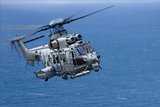
South Korean marines will adopt a Marine Attack Helicopter design based on the MUH-1. (Image: KAI)
KAI’s contract to develop a home-grown marine attack helicopter for South Korea’s marine corps means the service will not field a dedicated tandem-seat design such as the Apache or Viper.


On 27 October, Korea Aerospace Industries (KAI) signed a contract with South Korea’s Defense Acquisition Program Administration (DAPA) that covered development of a new attack helicopter.
The contract was worth KRW438.4 billion ($307.4 million), and at the end of the 46-month development period, KAI will have completed three prototype Marine Attack Helicopters (MAHs).
The MAH is based on the MUH-1 Marineon, itself a variant of the KUH-1 Surion. Because of this commonality (claimed to be running at 96% with the MUH-1) and interoperability, KAI said it should ‘reduce the budget and improve air operational capability’.
It will also
Our news & analysis is now part of Defence Insight®
A Basic-level or higher Defence Insight subscription is now required to view this content.

You may also like
More from Air Warfare
-
![France earmarks further $11.6 billion for missiles and drones amid rearmament push]()
France earmarks further $11.6 billion for missiles and drones amid rearmament push
The revised funding allocation will see up to 23% of the additional budget put towards stockpiles of munitions, with the country’s GDP spending expected to reach 2.5% by 2030.
-
![First GCAP contract marks milestone for Edgewing, while UK waits on further funding]()
First GCAP contract marks milestone for Edgewing, while UK waits on further funding
The design and development contract is set to run until the end of June and will now enable the partnership to drive the programme forward as it targets its 2027 demonstrator date.
-
![UK SMEs remain vulnerable in effort to help build sovereign capabilities, JCNSS report warns]()
UK SMEs remain vulnerable in effort to help build sovereign capabilities, JCNSS report warns
The report comes as heads of industry bodies warn that the delayed defence spending plan has left smaller and medium sized businesses in stasis, unable to plan or seek out further investment.
-
![Norway revitalises effort to acquire a tactical-class UAV with $103 million competition]()
Norway revitalises effort to acquire a tactical-class UAV with $103 million competition
Norway first scoped the requirement in 2022, and included it in a defence strategy document in 2023. The announcement of a new framework agreement appears to have breathed fresh life into the effort.
-
![March Drone Digest: Long-range, low-cost loitering munitions are changing warfare economics]()
March Drone Digest: Long-range, low-cost loitering munitions are changing warfare economics
The effective use of the Shahed-136 in the Iran war has highlighted the need for countries to acquire a domestically produced, low-cost, long-range loitering munition, with the US, Turkey and European nations all at various stages of developing a similar capability.
-
![Franco-German alliance aims to resolve FCAS woes by end of April as dispute rolls on]()
Franco-German alliance aims to resolve FCAS woes by end of April as dispute rolls on
The disagreement between French-German industry continues as both governments work to keep the programme alive and on track to develop and deliver a sixth-generation fighter jet.