AI mission-autonomy software integration and partnerships see progress across CCA efforts
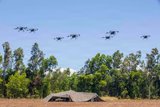
The USAF has now validated open systems architecture for use on Increment 1 CCA prototypes. (Photo: USAF)
The successful integration of third-party mission autonomy in the US Air Force’s CCA programme and movement on Helsing’s Europa CA-1 timelines mark key milestones in the development of uncrewed aerial capabilities.


Further advancement has been made towards mission autonomy integration with the US Air Force’s (USAF) Collaborative Combat Aircraft (CCA) programme, with European CCA programmes also taking steps towards autonomy integration in their uncrewed aerial vehicle (UAV) prototypes.
The USAF announced the validation of its Autonomy Government Reference Architecture (A-GRA) last week – allowing Shield AI and RTX, as the programme’s mission autonomy companies, to integrate their software via this open architecture into General Atomics Aeronautical Systems’ (GA-ASI) and Anduril’s CCA YFQ-42A and YFQ-44A prototypes.
Shield AI’s Hivemind autonomy software and RTX were reportedly selected by the USAF to support its Increment 1 CCA
Our news & analysis is now part of Defence Insight®
A Basic-level or higher Defence Insight subscription is now required to view this content.


More from Air Warfare
-
![USAF eyes sensor and weapon upgrades as MH-139A Grey Wolf achieves IOC]()
USAF eyes sensor and weapon upgrades as MH-139A Grey Wolf achieves IOC
The Grey Wolf has entered operational service nearly three years later than originally planned, while new sustainment contracts indicate that some UH-1Ns could remain supported until 2031.
-
![How geopolitics and new military alliances are disrupting combat aircraft procurement]()
How geopolitics and new military alliances are disrupting combat aircraft procurement
Selection of fighter aircraft by national governments has always been political. As markets and allegiances shift against a background of global realignment, who will be the winners and losers as new entrants compete with established suppliers?
-
![Singapore’s interest in GCAP reflects its long-term approach to air power]()
Singapore’s interest in GCAP reflects its long-term approach to air power
A potential interest in joining GCAP is indicative of Singapore’s long-term and methodical approach to defence procurement and could benefit its local defence industry.
-
![Extending mission readiness: where XR adds real value in pilot, crew and maintenance training]()
Extending mission readiness: where XR adds real value in pilot, crew and maintenance training
Extended reality (XR) is becoming increasingly relevant in military aviation training, adding a flexible layer to an integrated ecosystem spanning the pilot, crew, and maintenance domains.
-
![US military tests AI-powered CUAS turret against drone swarms]()
US military tests AI-powered CUAS turret against drone swarms
As the US continues to invest heavily in counter-drone systems, demand for low-cost, mobile and autonomous technologies is on the rise, with Edda designed to align with these emerging requirements.
-
![August crewed air review: KC-390 momentum builds as demand in the tanker market grows]()
August crewed air review: KC-390 momentum builds as demand in the tanker market grows
The KC-390 is building a growing international operator base, but competition in the transport and tanker market is increasingly likely to depend on interoperability, commonality and the strength of supporting ecosystems. Meanwhile, Boeing’s KC-46 and Airbus’s A330 also gained ground in August.