South Korean marines to receive ‘semi-attack’ helicopters
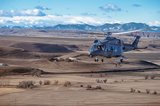
An artist's rendering of a Marine Attack Helicopter in action. (KAI)
On the cards for South Korea’s military are Marineon-based attack helicopters, more Apache Guardians and more MH-60Rs.


The future make-up of the ROK Marine Corps (ROKMC) Air Group has been decided after a decision was made on which attack helicopter would equip it. In fact, the chosen platform is not an attack helicopter at all, not really, as the force will receive armed versions of the MUH-1 Marineon built by Korea Aerospace Industries (KAI).
A Defense Acquisition Program Administration (DAPA) meeting on 26 April decreed that 24 armed Marine Attack Helicopters (MAH) would be built for the ROKMC. They should all be delivered by 2031.
‘By introducing marine attack helicopters, the marines’ operational capability of amphibious assault
Our news & analysis is now part of Defence Insight®
A Basic-level or higher Defence Insight subscription is now required to view this content.

More from Air Warfare
-
![Extending mission readiness: where XR adds real value in pilot, crew and maintenance training]()
Extending mission readiness: where XR adds real value in pilot, crew and maintenance training
Extended reality (XR) is becoming increasingly relevant in military aviation training, adding a flexible layer to an integrated ecosystem spanning the pilot, crew, and maintenance domains.
-
![US military tests AI-powered CUAS turret against drone swarms]()
US military tests AI-powered CUAS turret against drone swarms
As the US continues to invest heavily in counter-drone systems, demand for low-cost, mobile and autonomous technologies is on the rise, with Edda designed to align with these emerging requirements.
-
![August crewed air review: KC-390 momentum builds as demand in the tanker market grows]()
August crewed air review: KC-390 momentum builds as demand in the tanker market grows
The KC-390 is building a growing international operator base, but competition in the transport and tanker market is increasingly likely to depend on interoperability, commonality and the strength of supporting ecosystems. Meanwhile, Boeing’s KC-46 and Airbus’s A330 also gained ground in August.