General Atomics advances crewed-uncrewed teaming
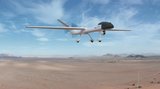
This demonstration proved the capability of the rapidly maturing Autonomous Collaborative Platform mission system suite through teamwork by four established primes. (Photo: Tactical Air Support)
General Atomics has successfully demonstrated new potential for crewed-uncrewed teaming with a focus on IR sensing and communication.


General Atomics Aeronautical Systems successfully paired an MQ-20 Avenger UAS with a Sabreliner business jet and two F-5 Advanced Tiger fighter jets, demonstrating the potential for MUM-T in IR sensing.
The Sabreliner was operated by Lockheed Martin and acted as a surrogate fighter, while the F-5s from Tactical Air Support were configured with internal Tactical Infrared Search and Track (TacIRST) sensors to perform multi-platform IR sensing.
All live aircraft had operational next-generation TacIRST sensors during the test to provide air-to-air moving target tracking.
Related Articles
HII demonstrates crewed and uncrewed maritime operations
General Atomics claims fully autonomous AI-piloted flight with Avenger MQ-20A
This data was then processed on a General Dynamics Mission Systems’ EMC2 Multi-Function Processor. Using this software-defined architecture, the flight demonstrated MUM-T capabilities between the MQ-20s, Sabreliner and crewed F-5 tactical fighters.
During the demonstration, all aircraft performed coordinated manoeuvres to sense relevant airborne targets in the IR spectrum.
The MQ-20 and Sabreliner were digitally connected over a Tactical Targeting Network Technology mesh network to share sensing observations.
In addition to the live-flight aircraft, five digital twins of the MQ-20 were integrated to autonomously fly a Live, Virtual, Constructive collaborative combat mission.


More from Air Warfare
-
![E-3 Sentry encryption equipment no longer meets US security requirements, says USAF]()
E-3 Sentry encryption equipment no longer meets US security requirements, says USAF
The US Air Force says the Sentry fleet’s DAR-400 encryptor can no longer keep pace with changing security requirements and warns that a failure could affect US operations and data security.
-
![Spain air focus: Mature UAV market rewards early supplier engagement]()
Spain air focus: Mature UAV market rewards early supplier engagement
Spain accounts for 5% of European military UAV spending, broadly in line with its share of the continent’s wider defence market. What sets the country apart, however, is how much of that spending has already been committed, reflecting Spain's earlier adoption of the capability.
-
![New US Army UH-60M Black Hawk order bridges uncertain path to MV-75 transition]()
New US Army UH-60M Black Hawk order bridges uncertain path to MV-75 transition
The US$234 million award for 16 Sikorsky UH-60Ms preserves near-term production, but funding uncertainty and an undefinitised contract leave the US Army’s long-term Black Hawk requirements unresolved.