GA-ASI produces first EagleEye radar
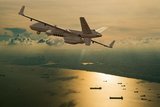
The EagleEye multi-mode radar will allow operation outside the Weapons Effects Zones of most threat systems. (Photo: GA-ASI)
EagleEye will act as a “drop-in” radar upgrade for US UAS.


The first new EagleEye multi-mode radar came off the production line of General Atomics Aeronautical Systems, Inc. (GA-ASI) at the end of June 2024. The high-performance radar delivers high-resolution, photographic-quality imagery through clouds, rain, dust, smoke and fog at several times the range of previous radars, its manufacturer claimed.
EagleEye will be used as a “drop-in” radar enhancement for the Gray Eagle Extended the initial configuration for the new Gray Eagle 25M (GE 25M) UAS. The Army National Guard initially ordered 12 of the Gray Eagle 25M units.
Shephard has forecast that an additional 12 units, 24 in total, will be required at minimum. In January 2023, retired Col. Mike Hadley, vice-president for government affairs for the Army National Guard Association, clarified that 12 units would be “just the start”, as only one Guard division would be equipped with Gray Eagle UAVs out of the “eight” that “urgently need them”.
Related Articles
Australian Army maintains interest in passive C-UAS radar
QinetiQ presents on-the-move capability with Obsidian C-UAS radar
Hadley’s hope in 2023 was that the National Guard would end up with an inventory of some 96 units (at a Shephard-projected cost of US$1,175.16 million) seems unlikely to be fulfilled at any time in the short-term future. The 24-unit configuration though, with its likely price tag of $167.88 million, might be possible in the short-to-medium-term future.
Earlier in 2024, GA-ASI announced the development of a new Active Electronically Scanned Array (AESA) antenna and associated software for EagleEye which will increase the radar’s range. Combined with optimised multi-mode performance, the platform will let the aircraft operate significantly outside the Weapons Effects Zone of most threat systems.
Related Programmes in Defence Insight



More from Air Warfare
-
![USAF eyes sensor and weapon upgrades as MH-139A Grey Wolf achieves IOC]()
USAF eyes sensor and weapon upgrades as MH-139A Grey Wolf achieves IOC
The Grey Wolf has entered operational service nearly three years later than originally planned, while new sustainment contracts indicate that some UH-1Ns could remain supported until 2031.
-
![How geopolitics and new military alliances are disrupting combat aircraft procurement]()
How geopolitics and new military alliances are disrupting combat aircraft procurement
Selection of fighter aircraft by national governments has always been political. As markets and allegiances shift against a background of global realignment, who will be the winners and losers as new entrants compete with established suppliers?
-
![Singapore’s interest in GCAP reflects its long-term approach to air power]()
Singapore’s interest in GCAP reflects its long-term approach to air power
A potential interest in joining GCAP is indicative of Singapore’s long-term and methodical approach to defence procurement and could benefit its local defence industry.
-
![Extending mission readiness: where XR adds real value in pilot, crew and maintenance training]()
Extending mission readiness: where XR adds real value in pilot, crew and maintenance training
Extended reality (XR) is becoming increasingly relevant in military aviation training, adding a flexible layer to an integrated ecosystem spanning the pilot, crew, and maintenance domains.
-
![US military tests AI-powered CUAS turret against drone swarms]()
US military tests AI-powered CUAS turret against drone swarms
As the US continues to invest heavily in counter-drone systems, demand for low-cost, mobile and autonomous technologies is on the rise, with Edda designed to align with these emerging requirements.
-
![August crewed air review: KC-390 momentum builds as demand in the tanker market grows]()
August crewed air review: KC-390 momentum builds as demand in the tanker market grows
The KC-390 is building a growing international operator base, but competition in the transport and tanker market is increasingly likely to depend on interoperability, commonality and the strength of supporting ecosystems. Meanwhile, Boeing’s KC-46 and Airbus’s A330 also gained ground in August.