Four companies chosen for COTS, dual-use air-launched system
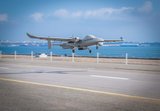
An artist’s impression of Zone 5 Technologies bid for ETV. (Image: Zone 5 Technologies)
An enterprise test vehicle (ETV) will use dual-use and commercial-off-the-shelf (COTS) technology to develop an air-launched multi-purpose system with an emphasis on modularity.


Four companies have been selected by the US Air Force Armament Directorate (AFLCMC/EB) and the Defense Innovation Unit (DIU) to develop prototype solutions for an ETV, an air-launched weapon or sensor.
The effort will attempt to identify and prototype commercial and dual-use technology solutions for an ETV that demonstrates modularity for subsystem upgrade testing. The technology will also serve as a foundation for affordable high-rate production.
On 4 June, the DIU said: “Initial flight demonstrations will occur within seven months from the agreement award dates, after which one or multiple of the most promising prototypes will continue development towards a production variant capable of rapidly scalable manufacture.”
Cassie Johnson, the armament directorate’s ETV programme manager, said COTS products would provide benefits in development efforts.
“We have become convinced that widening the aperture to include more non-traditional aerospace companies offers the best chance at accomplishing our cost-per-unit goals, project timeline and production quantity goals,” Johnson said.
The companies selected to develop prototype solutions for flight demonstration were Anduril Industries, Integrated Solutions for Systems, Leidos Dynetics and Zone 5 Technologies to develop prototype solutions for flight demonstration in the second half of 2024. The companies were chosen from more than 100 commercial and dual-use technology company applicants.
Additional ETV government project collaborators and evaluators include Air Force Research Laboratory, Special Operations Command, Naval Air Systems Command and US Indo-Pacific Command.

You may also like
More from Air Warfare
-
![July drone digest: Sovereign production takes centre stage at Farnborough]()
July drone digest: Sovereign production takes centre stage at Farnborough
Farnborough International Airshow (FIA) 2026 revealed the growing scale of the UK’s uncrewed ambitions, with companies showcasing new CCA, autonomous wingmen and surveillance drones, while sovereign production emerged as a key factor for multiple programmes.
-
![July air forces review: Farnborough steals the headlines as programmes develop]()
July air forces review: Farnborough steals the headlines as programmes develop
The biannual Farnborough International Airshow 2026 was the backdrop in July for scores of deals, partnerships and announcements, including developments in the multinational next-generation Global Combat Air Programme and the UK’s $486 million trainer aircraft requirement.
-
![FIA 2026: Bell highlights MOSA-driven growth path for MV-75 Cheyenne]()
FIA 2026: Bell highlights MOSA-driven growth path for MV-75 Cheyenne
Bell Flight’s modular open-systems approach for the US Army’s MV-75 Cheyenne could open doors for international allies and suppliers once locked out by closed rotorcraft architectures.
-
![Maximise survivability with advanced electronic warfare (video)]()
Maximise survivability with advanced electronic warfare (video)
BAE Systems’ all-digital EW delivers 360-degree threat awareness in contested environments, boosts survivability, and cuts lifecycle costs.
-
![US Air Force seeks avionics upgrades for ageing T-38 Talon as T-7A Red Hawk delays persist]()
US Air Force seeks avionics upgrades for ageing T-38 Talon as T-7A Red Hawk delays persist
The USAF is looking for commercial avionics solutions to improve the T-38 Talon’s reliability, readiness and flight safety as continued T-7A Red Hawk delays increase the likelihood that the legacy trainer will remain in service longer than planned.
-
![British Army’s Project Corvus selection highlights new era of drone sovereignty]()
British Army’s Project Corvus selection highlights new era of drone sovereignty
The UK’s choice of the Tekever AR5 for Project Corvus reflects a wider shift in military drone procurement towards solutions that centre on sovereignty and domestic production, moving away from overseas reliance.