First three F-16V fighter jets head to Bahrain
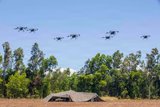
Bahrain has been an important partner for the US and is also the home of the US Navy’s Fifth Fleet headquarters. (Photo: Lockheed Martin)
Bahrain, long an operator of F-16s within the Gulf Cooperation Council, will become the first customer to adopt the newest and most advanced configuration of the renowned Lockheed Martin F-16 fighter.


The first three Lockheed Martin F-16 Block 70 (also known as F-16V) fighter jets have departed the manufacturer’s South Carolina facility for delivery to Bahrain.
The country was the first F-16 operator in the Gulf Cooperation Council beginning in the early 1990s and is the first customer to procure what Lockheed Martin called the “newest and most advanced F-16 production configuration”. Bahrain signed a US$1.2 billion contract in 2017 for the procurement of 16 new F-16 Viper Block 70 aircraft.
Lockheed said it has so far produced five of the fighters, with an additional 11 in various stages of production and testing.
“With the introduction of the F-16 Block 70, we are witnessing a significant leap in fighter capabilities,” said OJ Sanchez, VP and GM of the integrated fighter group at Lockheed Martin. “The integration of this proven platform will allow the Royal Bahraini Air Force to safeguard its skies effectively and partner with allies worldwide.”
The Block 70/72 currently has a planned backlog of 133 jets, but Lockheed Martin told Shephard last month that it has been calculating with these numbers and was executing orders per plan.
Bahrain has been an important partner for the US and has been home of the US Navy’s Fifth Fleet headquarters. It currently operates 20 F-16 Block 40 jets. The latest configuration of the fourth-generation fighter will considerably increase the country’s air power.
Related Programmes in Defence Insight
Related Equipment in Defence Insight

More from Air Warfare
-
![USAF eyes sensor and weapon upgrades as MH-139A Grey Wolf achieves IOC]()
USAF eyes sensor and weapon upgrades as MH-139A Grey Wolf achieves IOC
The Grey Wolf has entered operational service nearly three years later than originally planned, while new sustainment contracts indicate that some UH-1Ns could remain supported until 2031.
-
![Extending mission readiness: where XR adds real value in pilot, crew and maintenance training]()
Extending mission readiness: where XR adds real value in pilot, crew and maintenance training
Extended reality (XR) is becoming increasingly relevant in military aviation training, adding a flexible layer to an integrated ecosystem spanning the pilot, crew, and maintenance domains.
-
![US military tests AI-powered CUAS turret against drone swarms]()
US military tests AI-powered CUAS turret against drone swarms
As the US continues to invest heavily in counter-drone systems, demand for low-cost, mobile and autonomous technologies is on the rise, with Edda designed to align with these emerging requirements.
-
![August crewed air review: KC-390 momentum builds as demand in the tanker market grows]()
August crewed air review: KC-390 momentum builds as demand in the tanker market grows
The KC-390 is building a growing international operator base, but competition in the transport and tanker market is increasingly likely to depend on interoperability, commonality and the strength of supporting ecosystems. Meanwhile, Boeing’s KC-46 and Airbus’s A330 also gained ground in August.