Elbit to deliver EW self-protection suites for a European country’s C-390 and H225M aircraft
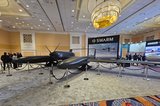
The systems are for Embraer C390 Millennium aircraft and Airbus H225M helicopters. (Image: Elbit Systems)
The system to be installed includes a digital radar warning receiver, infra-red missile warning system, laser warning system, countermeasure dispenser system and DIRCM (Directed Infrared Countermeasure) system.


Elbit System has been awarded a US$175 million contract to supply electronic warfare (EW) and DIRCM self-protection suites to a NATO European country for installation on Embraer C-390 Millennium aircraft and Airbus H225M helicopters.
As part of the C-390 contract, Elbit Systems will provide its Self Protection Electronic Attack and Reconnaissance (SPEAR) electronic countermeasure pod, which can be transferred between aircraft.
Additionally, the C-390 contract includes an agreement with another European country, providing for the delivery of the EW suite for installation on C-390s.
The system to be installed includes a range of warning, detection and counter-measure systems as well as MUSIC (Multi-Spectral Infrared Countermeasure) systems.
The contracts are expected to be executed over the course of this decade.
The names of the countries were not disclosed but only Hungary operates both types. Another NATO country operating the C-390 is Portugal, with the Czech Republic and the Netherlands also due to receive the aircraft.
These add to several other contracts awarded to the company over the past year for equipping various fixed-wing and rotary-wing aircraft, including Boeing Chinook heavy-lift helicopters and Airbus H145M helicopters with self-protection suites.
As well as standard MUSIC the system also comes as J-MUSIC for medium-to-large fixed-wing aircraft and C-MUSIC for Israeli commercial aircraft.
Related Equipment in Defence Insight

You may also like
More from Air Warfare
-
![V-22 Osprey safety upgrade moves towards wider fleet installation under $35.5 million deal]()
V-22 Osprey safety upgrade moves towards wider fleet installation under $35.5 million deal
Bell Boeing will supply 73 additional ODSSHI kits as NAVAIR prepares to introduce predictive drive-system monitoring across US and Japanese V-22 fleets.
-
![AFA 2026: USAF examines uncrewed cargo aircraft for contested logistics]()
AFA 2026: USAF examines uncrewed cargo aircraft for contested logistics
The US Air Force is evaluating demonstrators for uncrewed cargo missions as it considers logistics requirements across the Pacific and other contested environments.
-
![Germany air focus: Europe’s leading near-term air market targets domestic industry]()
Germany air focus: Europe’s leading near-term air market targets domestic industry
Between 2026 and 2032, almost a quarter of EU aircraft spending is expected to come from Germany. While crewed programmes seek modernisation and replacement, uncrewed opportunities look to introduce entirely new capabilities, with both highlighting sovereignty and domestic production.
-
![Europe risks losing control of CUAS production capacity as manufacturers look abroad]()
Europe risks losing control of CUAS production capacity as manufacturers look abroad
European counter-drone developers are securing early orders in the Middle East while slow domestic acquisition processes threaten to redirect production capacity, expertise and investment away from Europe.
-
![India’s rotary-wing capability gap grows as IMRH programme delays persist]()
India’s rotary-wing capability gap grows as IMRH programme delays persist
With IMRH and DBMRH potentially years from service, India faces a widening rotary-wing capability gap that could drive further foreign purchases even as HAL and Safran build the foundations of an indigenous successor.
-
![AFA 2026: Swarm Aero eyes 2027 Gamera flight as Textron/Merlin reveal SkyCourier UX]()
AFA 2026: Swarm Aero eyes 2027 Gamera flight as Textron/Merlin reveal SkyCourier UX
Two new uncrewed aircraft concepts target very different US military requirements, from massed long-range strike to autonomous logistics. Shephard spoke with executives from Swarm Aero, Textron Aviation and Merlin Labs at this year's AFA Air, Space & Cyber conference to learn more about their capabilities.