DARPA strives for the future helicopter pilot
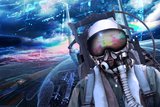
Northrop Grumman's AI technology will help pilots to see more, as shown by the above depiction. (Image: Northrop Grumman)
US DARPA has contracted Northrop Grumman to develop a rotorcraft pilot AI assistant.


Northrop Grumman has been awarded a contract from the US DARPA’s Perceptually-enabled task Guidance Program to develop a prototype AI assistant.
The prototype will be embedded in an AR headset to help rotary pilots perform expected and unexpected tasks.
The company, in partnership with the University of Central Florida, will develop an operator and context-adaptive reasoning intuitive assistant (OCARINA) that will support UH-60 Blackhawk pilots.
Erin Cherry, senior autonomy program manager, Northrop Grumman, stated: ‘It will help teach new tasks, aid in the recognition and reduction of errors, improve task completion time and help to prevent catastrophic events.’
Currently, simple warning systems are the most common means for aiding a rotorcraft aircraft, such as auditory alerts to increase altitude.
However, these warning systems are limiting and can induce unanticipated cognitive burdens on pilots. In fact, studies have shown that inattentional blindness to such warnings can occur.
DARPA’s PTG program aims to provide users with wearable sensors which allow the AI assistant to provide feedback and guidance through speech and aligned graphics.
This decision follows a series of UH-60 crashes in 2021, including one which occurred in Idaho on 2 February and another which occurred in New York state on 20 January.


More from Air Warfare
-
![July drone digest: Sovereign production takes centre stage at Farnborough]()
July drone digest: Sovereign production takes centre stage at Farnborough
Farnborough International Airshow (FIA) 2026 revealed the growing scale of the UK’s uncrewed ambitions, with companies showcasing new CCA, autonomous wingmen and surveillance drones, while sovereign production emerged as a key factor for multiple programmes.
-
![July air forces review: Farnborough steals the headlines as programmes develop]()
July air forces review: Farnborough steals the headlines as programmes develop
The biannual Farnborough International Airshow 2026 was the backdrop in July for scores of deals, partnerships and announcements, including developments in the multinational next-generation Global Combat Air Programme and the UK’s $486 million trainer aircraft requirement.
-
![Maximise survivability with advanced electronic warfare (video)]()
Maximise survivability with advanced electronic warfare (video)
BAE Systems’ all-digital EW delivers 360-degree threat awareness in contested environments, boosts survivability, and cuts lifecycle costs.
-
![US Air Force seeks avionics upgrades for ageing T-38 Talon as T-7A Red Hawk delays persist]()
US Air Force seeks avionics upgrades for ageing T-38 Talon as T-7A Red Hawk delays persist
The USAF is looking for commercial avionics solutions to improve the T-38 Talon’s reliability, readiness and flight safety as continued T-7A Red Hawk delays increase the likelihood that the legacy trainer will remain in service longer than planned.
-
![British Army’s Project Corvus selection highlights new era of drone sovereignty]()
British Army’s Project Corvus selection highlights new era of drone sovereignty
The UK’s choice of the Tekever AR5 for Project Corvus reflects a wider shift in military drone procurement towards solutions that centre on sovereignty and domestic production, moving away from overseas reliance.