CF-18 Hornet Extension Project achieves IOC
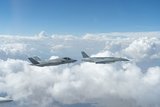
All RCAF CF-18 Hornet aircraft have been scheduled for retirement in 2032. (Photo: US Air Force / Senior Airman Julia Lebens)
The project extension continues to address the capability gap in the Canadian Armed Forces to meet its fighter aircraft commitments for both NORAD and NATO.


The Royal Canadian Air Force (RCAF) has announced its CF-18 Hornet Extension Project (HEP) has achieved Initial Operational Capability (IOC).
As part of a joint effort with the F/A-18 and EA-18G programme office (PMA-265), HEP will ensure the RCAF CF-18 Hornet fighter fleet can meet operational commitments to the North American Aerospace Defence Command (NORAD) and NATO until 2032, the RCAF stated. From then on, the fleet will be retired and replaced with F35-As under Canada’s future fighter capability project.
The IOC also marked the delivery of the first six HEP2 upgraded fighter aircraft to the RCAF. A total of 84 aircraft will be upgraded which RCAF said would provide all 84 aircraft with HEP 1 interoperability upgrades and 36 aircraft with HEP 2 combat capability upgrades. According to the RCAF, Full Operational Capability on all 84 aircraft is predicted to be achieved by the first half of 2026.
“Achieving this milestone and ensuring the timely delivery of the first six aircraft required extensive coordination and cooperation among industry partners, PMA-265 and the Navy F/A-18 enterprise, including the Air Weapons Laboratory and radar teams at the Naval Air Weapons Station China Lake,” said Don Valentine, PMA-265 Canadian and Spanish F/A-18 programme manager.
PMA-265 provides current and future capabilities for the F/A-18A-D Hornet, F/A-18E/F Super Hornet and the GA-18G Growler, in the form of life cycle support management and weapons systems.
Related Programmes in Defence Insight
Future Fighter Capability Project [Canada]
Related Equipment in Defence Insight

More from Air Warfare
-
![UK eyes lightweight satellite communications for UAVs]()
UK eyes lightweight satellite communications for UAVs
The UK is seeking to extend the operational reach of uncrewed aerial vehicles, reflecting growing demand for compact, energy-efficient technology to support beyond-line-of-sight operations.
-
![The new generation of defence companies emerging from the US UAV boom]()
The new generation of defence companies emerging from the US UAV boom
As the Pentagon accelerates procurement of low-cost, lethal UAVs through its Drone Dominance Program, emerging suppliers will need to demonstrate manufacturing capacity, supply chain resilience and reliability.
-
![US Coast Guard faces key procurement decisions after C-130J and MQ-9B orders]()
US Coast Guard faces key procurement decisions after C-130J and MQ-9B orders
The service is updating several parts of its aviation fleet including fixed-wing and rotary-wing aircraft and procuring uncrewed aircraft to boost its maritime surveillance.