Airbus outlines Logistics Connector plan and partners with L3Harris
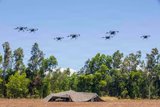
Airbus has said it is aiming to have a flyable prototype of the Logistics Connector MQ-72C by 2028. (Image: Airbus Space and Defense)
Airbus says it will aim to have a working prototype of the MQ-72C Logistics Connector by the end of the decade as it bids for a contract with the US Marine Corps.


Airbus US Space and Defense will aim to have a flyable prototype of the Logistics Connector MQ-72C by 2028 and have a final design ready for full production by 2029.
“We want to be ready for low-rate initial production (LRIP) by 2030 if that’s what US Naval Air Systems Command (NAVAIR) wants to do,” said Rob Geckle, chairman and CEO of Airbus US Space and Defense.
The company has been competing for a contract for the US Marines Corps (USMC) to develop Connector, an autonomous vertical take-off and landing (VTOL) uncrewed aerial system (UAS) designed for transportation operations in contested
Our news & analysis is now part of Defence Insight®
A Basic-level or higher Defence Insight subscription is now required to view this content.




More from Air Warfare
-
![US Pentagon pushes procurement of dismounted counter-UAS capabilities]()
US Pentagon pushes procurement of dismounted counter-UAS capabilities
The US services are investing in lighter, autonomous and networked systems to protect mobile troops from drone threats.
-
![US Army extended-range CUAS missile ramjet work to continue through December 2029]()
US Army extended-range CUAS missile ramjet work to continue through December 2029
Northrop Grumman’s US$18.8 million XRC propulsion contract runs through December 2029, but performance targets and the pathway to operational fielding remain undisclosed.
-
![Saab’s GlobalEye gains ground as Canada’s aircraft procurement tilts towards Europe]()
Saab’s GlobalEye gains ground as Canada’s aircraft procurement tilts towards Europe
Canada’s interest in negotiating a procurement of Saab’s GlobalEye airborne early warning and control aircraft signals its readiness to reduce its reliance on US defence technology as trade tensions with its North American neighbour mount.
-
![US Air Force CCA programme to achieve multiple milestones in the coming months]()
US Air Force CCA programme to achieve multiple milestones in the coming months
The US Air Force is preparing to select mission-autonomy software, fire a missile from the FQ-42 Vengeance and test both CCA designs alongside crewed fighters at 2026 Emerald Flag.