Airbus enters race for unmanned Wingman support fighters
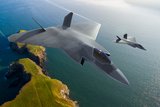
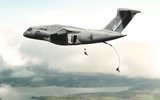
Airbus has thrown its hat into the uncrewed escort aircraft ring with Wingman. (Image: Airbus)
Designs for unmanned support aircraft for fighter jets are advanced with Boeing’s MQ-28A Ghost Bat beginning development in 2013 and making its first flight in February 2021 and Airbus’s effort will need to advance quickly to keep up.


Airbus is to display a full-size concept of its Wingman uncrewed escort aircraft at the ILA Berlin Air Show with a design which incorporates low observability, the integration of various armaments, advanced sensors, connectivity and teaming solutions.
Like other Wingman aircraft, such as the Boeing MQ-28A Ghost Bat which was previously called Loyal Wingman, it would be commanded by a pilot in a conventional combat aircraft such as the Eurofighter or F-35 to take on high-risk mission tasks and keep crewed aircraft safer.
Michael Schoellhorn, CEO of Airbus Defence and Space, said that he could see Wingman entering service over the next decade.
Related Articles
Avalon 2019: Secretive Loyal Wingman breaks cover
ATS achieves flight milestone and new contract
Russia looks ahead to 2024 for Okhotnik rollout
“The German Air Force has expressed a clear need for an unmanned aircraft flying with and supporting missions of its manned fighter jets before the Future Combat Air System will be operational in 2040,” Schoellhorn said.
Our Wingman concept [will] offer the German Air Force an affordable solution with the performance it needs to maximise the effects and multiply the power of its fighter fleet for the 2030s.”
The company’s said it hopes of getting the Wingman flying in less than a decade was challenging but it was something achieved by Boeing with its MQ-28A Ghost Bat, which turned the aircraft around from the unveiling of a full-size model in 2019 to first flight in 2021.
Additionally there have been other runners in the development of Wingman systems, as noted by Shephard Defence Insight, such as Saab Aerospace and a consortium led by BAE Systems, as well as countries like South Korea, Russia and Japan.



More from Air Warfare
-
![USAF eyes sensor and weapon upgrades as MH-139A Grey Wolf achieves IOC]()
USAF eyes sensor and weapon upgrades as MH-139A Grey Wolf achieves IOC
The Grey Wolf has entered operational service nearly three years later than originally planned, while new sustainment contracts indicate that some UH-1Ns could remain supported until 2031.
-
![How geopolitics and new military alliances are disrupting combat aircraft procurement]()
How geopolitics and new military alliances are disrupting combat aircraft procurement
Selection of fighter aircraft by national governments has always been political. As markets and allegiances shift against a background of global realignment, who will be the winners and losers as new entrants compete with established suppliers?
-
![Singapore’s interest in GCAP reflects its long-term approach to air power]()
Singapore’s interest in GCAP reflects its long-term approach to air power
A potential interest in joining GCAP is indicative of Singapore’s long-term and methodical approach to defence procurement and could benefit its local defence industry.
-
![Extending mission readiness: where XR adds real value in pilot, crew and maintenance training]()
Extending mission readiness: where XR adds real value in pilot, crew and maintenance training
Extended reality (XR) is becoming increasingly relevant in military aviation training, adding a flexible layer to an integrated ecosystem spanning the pilot, crew, and maintenance domains.
-
![US military tests AI-powered CUAS turret against drone swarms]()
US military tests AI-powered CUAS turret against drone swarms
As the US continues to invest heavily in counter-drone systems, demand for low-cost, mobile and autonomous technologies is on the rise, with Edda designed to align with these emerging requirements.
-
![August crewed air review: KC-390 momentum builds as demand in the tanker market grows]()
August crewed air review: KC-390 momentum builds as demand in the tanker market grows
The KC-390 is building a growing international operator base, but competition in the transport and tanker market is increasingly likely to depend on interoperability, commonality and the strength of supporting ecosystems. Meanwhile, Boeing’s KC-46 and Airbus’s A330 also gained ground in August.