Work begins on second Italian Navy PPA
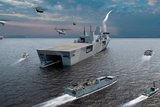
Fincantieri has begun construction of the second Italian Navy Multipurpose Offshore Patrol Ship (PPA), the company announced on 3 October.
The unit will be delivered in 2022 and is part of the Italian Navy vessel renewal plan which started in May 2015.
The 132.5m PPA will serve multiple functions, ranging from patrol with sea rescue capacity to civil protection operations, and, in its most highly equipped version, first line fighting vessel.
The PPA will have a speed of over 31 knots and a combined diesel, electric and a gas turbine plant. It will come in different configurations: starting from a ‘soft’ version for the patrol task, an integrated self-defence variant, and a variant equipped to deal with three-dimensional threats, including both air and surface.
The vessel will also be capable of operating rigid hull inflatable boat up to 11m long through lateral cranes or a hauling ramp located at the far stern.





More from Naval Warfare
-
![US Navy’s $275 billion BBGN plan hinges on shipyard transformation]()
US Navy’s $275 billion BBGN plan hinges on shipyard transformation
The US Navy’s planned nuclear-powered warship carries a US$275 billion price tag, but the greater story lies in the industrial overhaul needed to build it, from AI-enabled design to digital twins and modular construction.
-
![RTX confirms US Marine Corps and US Navy acquire Hadalus UUV]()
RTX confirms US Marine Corps and US Navy acquire Hadalus UUV
RTX told Shephard that the Hadalus UUV has been procured by the US Marine Corps and the Office of Naval Research for operational experimentation as the company prepares additional demonstrations with the US Navy, NATO and AUKUS partners.
-
![Europe’s naval contractors benefit from growing refit and upgrade demand]()
Europe’s naval contractors benefit from growing refit and upgrade demand
Rheinmetall’s order to modernise the German Navy frigate Bayern points to a wider European shift towards extending warship service life as new-build programmes face delay.
-
![The UK joins the movement towards joint procurement]()
The UK joins the movement towards joint procurement
The UK will spend an estimated US$3.89 billion over the next decade in joint naval programmes, a lot of which will be in cooperation with Norway.