USS Zumwalt undocked after supersonic weapons upgrade
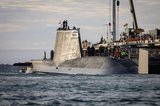
The USS Zuwalt has been undocked, prior to testing and a return to the fleet. (Photo: HII Ingalls Shipbuilding)
The vessel will be the first in the US fleet to carry the Conventional Prompt Strike capability.


The USS Zumwalt, the class leader of the US Navy’s (USN’s) Zumwalt class of guided missile destroyers, has been undocked by HII’s Ingalls Shipbuilding division.
The three vessels in the class were chosen in January 2023 to be the first ships in the US Navy that would field hypersonic weapons.
In August 2023, Ingalls was awarded a US$155 million contract to carry out the modernisation work on the USS Zumwalt’s weapon systems.
Related Articles
The future is hypersonic strike for Zumwalt destroyers
Ingalls Shipbuilding awarded $155 million contract for USS Zumwalt modernisation
Zumwalt-class destroyers begin surface-strike platform transformation
Shortly after its arrival at the Ingalls Pascagoula shipyard, the ship was put back on land in order to receive technology upgrades, including the integration of the Conventional Prompt Strike (CPS) weapon system. The Ingalls team also replaced the original twin 155mm Advanced Gun Systems on the destroyer with new missile tubes.
When released back to the fleet, the Zumwalt will be the first vessel in the USN to carry the CPS system, although the Navy’s plan is that the entire Zumwalt class will carry it before 2030.
The undocking takes the USS Zumwalt one step closer to its testing phase and eventual return to the fleet with its upgraded weaponry.
The use of the Zumwalt class as standard-bearers for new weapons platforms is a turnaround for the vessels. Originally, the class, contracted to General Dynamics Bath Iron Works in 2008, was due to comprise 32 ships, but delays accrued and costs skyrocketed.
By 2009, the programme had already cost the US Defense Department $8.4 billion, leaving the class quickly capped at those three initial vessels.
The CPS system and hypersonic missiles will turn the Zumwalt class into an unofficial special weapons group until the systems are more widely distributed across the fleet.
Armed with its hypersonic weapons, the class will be capable of both power projection, deterrence and command and control operations while other vessels in the fleet are upgraded to new and similar systems.
Related Programmes in Defence Insight
Related Equipment in Defence Insight



More from Naval Warfare
-
![Five years on: where could opportunities emerge next for AUKUS Pillar II?]()
Five years on: where could opportunities emerge next for AUKUS Pillar II?
Payload commonality, combat systems and electronic warfare are emerging as likely priorities as the trilateral partnership balances building submarines with sharing industrial ecosystems.
-
![From the Baltic to the Gulf: where USV procurement is heading next]()
From the Baltic to the Gulf: where USV procurement is heading next
Saildrone’s new Copenhagen base is one sign of a larger shift, as navies globally turn to uncrewed vessels for surveillance and mine clearance.
-
![Israeli Navy looks to expand as war reshapes future force requirements]()
Israeli Navy looks to expand as war reshapes future force requirements
Israel’s navy is preparing for a larger and more technically diverse role, but its ambitions could be impacted by supply chain restrictions, accelerating demand for domestic naval production as well as autonomous maritime capabilities.
-
![Quantum sensing gathers pace as navies eye undersea advantage]()
Quantum sensing gathers pace as navies eye undersea advantage
As AI dominates defence conversations, industry increasingly points to quantum sensing as the technology set to change submarine and uncrewed underwater vehicle operations.