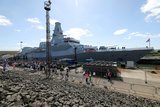
UK’s Fleet Solid Support ship programme deemed on track despite steel supply concerns
Shipbuilders are saying the programme is going ahead on time as the government estimates 7.7 million tonnes of steel are needed for 2026 infrastructure projects.
The US Navy’s new aircraft carrier, USS Gerald R Ford, has received its first advanced weapons elevator (AWE), the navy announced on 16 January.
AWE Upper Stage 1 was turned over to the ship on 21 December, following testing and certification at Huntington Ingalls Industries-Newport News Shipbuilding, where the ship is currently undergoing its post-shakedown availability.
USS Gerald R Ford is the first Ford-class aircraft carrier, featuring new AWEs that are controlled via electromagnetic, linear synchronous motors, which allow for quick movement of weapons. The new design will allow the ship to be able to move up to 24,000lbs of ordnance at 150ft per minute.
The vessel features three upper stage elevators that move ordnance between the main deck and flight deck, and seven lower stage elevators that move ordnance between the main deck and the lower levels of the ship.
A separate utility elevator will serve as a dedicated elevator to move both ordnance and supplies, and also serve as a means to medically evacuate injured personnel from the flight deck to the hangar bay. This allows the ten main AWEs and Ford’s three aircraft elevators to be dedicated to their primary missions of ordnance and aircraft movement during real-world operations.
Shipbuilders are saying the programme is going ahead on time as the government estimates 7.7 million tonnes of steel are needed for 2026 infrastructure projects.
In an exclusive interview with Shephard, Raytheon’s VP of Shipboard Missiles disclosed what improvements the company plans to offer for the Sea Sparrow NSV.
Delays in the construction of the Polar Security Cutter – the future substitute for the Polar Star – are likely to prolong the ageing icebreaker’s service time even more, putting the USCG in a risky position.
The adaptable design of Babcock’s Arrowhead 140 frigate, already selected by the UK Royal Navy and Poland, has led to more orders from Indonesia while other countries continue to weigh it up.
The presence of the USS Abraham Lincoln Carrier Strike Group in the Persian Gulf means additional naval and aerial capabilities, which provides the US with multiple attacking options.
The US Navy’s acceleration of its laser weapon development initiatives reflects a decisive shift towards ultimately having a “laser on every ship” across tomorrow’s surface fleet.