Freedom completes Rough Water Trials


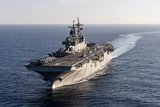
The US Navy has reported that that the Littoral Combat Ship USS Freedom (LCS 1) completed its Rough Water Trials (RWT) in late March, also known as Seakeeping and Structural Loads Trials.
During the RWT, the ship collected data at seat states five and six off the Oregon coast for 11 days. The ship was steered in an octagonal route at speeds ranging from dead stop to flank speed, and performance data at all speeds and orientations was captured.
The data was used to measure the ship structure’s stress, torsion and strain levels. It will be further analysed over the next few months to compare its performance with the modelled performance. Initial test results, according to the navy, are positive. The auxiliaries and machinery plant performed well.
During the tests, the crew members were also equipped with accelerometers and other sensors to evaluate human factors due to ship motions.
Once validated, the navy will be provided the conditions under which the USS Freedom and other variant ships can be operated.
The Freedom class ships are being built by an industry team led by Lockheed Martin, while the Independence variant is being built by a team led by General Dynamics, Bath Iron Works and Austal. A total of 12 ships are currently under construction.

You may also like
More from Naval Warfare
-
![How France’s SNLE 3G programme is reshaping the naval nuclear industrial base]()
How France’s SNLE 3G programme is reshaping the naval nuclear industrial base
Extending far beyond a four-submarine replacement programme, France’s ballistic missile submarine effort is a decades-long industrial effort designed to preserve the country’s ability to build and sustain nuclear-powered strategic platforms.
-
![China’s mineral processing dominance exposes naval supply chain vulnerabilities]()
China’s mineral processing dominance exposes naval supply chain vulnerabilities
Competition for critical minerals, and China’s dominance of their processing, is emerging as a decisive factor in future naval procurement programmes.
-
![Suppliers await next step in Australia’s mine warfare transition]()
Suppliers await next step in Australia’s mine warfare transition
Australia’s mine countermeasure capability remains in flux as the Huon-class nears retirement, but accelerated investment in autonomous systems is opening a path for industry.
-
![Can the US Navy ask Indo-Pacific allies to do more while training with them less?]()
Can the US Navy ask Indo-Pacific allies to do more while training with them less?
As the Iran War draws US ships and marine corps units away from the Indo-Pacific, curtailed exercises and a temporary carrier gap are exposing tensions between Washington’s demand for more self-reliant allies and the joint training needed to realise that ambition.
-
![How could Rheinmetall’s GMF 140 fit with ongoing programmes in North America?]()
How could Rheinmetall’s GMF 140 fit with ongoing programmes in North America?
With Canada committed to its River-class replacement and the USN pursuing a lower-cost frigate, Rheinmetall will need to demonstrate where the GMF 140 can fill a capability gap in the North American fleet.