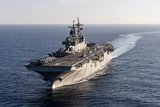
USS Carl Vinson Departs Haiti
The Nimitz-class aircraft carrier USS Carl Vinson (CVN 70) departed the waters near Port-au-Prince, Haiti Feb. 1 after rendering humanitarian assistance to the victims of a massive 7.0 earthquake that struck the Caribbean nation Jan. 12.
Arriving on station less than 72 hours after the quake, Carl Vinson immediately rendered assistance. Over two weeks, Vinson and its embarked 19 helicopters flew more than 2,200 sorties, delivering more than 166 tons of food, 89,000 gallons of water and 38,700 lbs. of medical supplies to earthquake victims.
Additionally, Vinson’s helicopters conducted 476 medical evacuations (MEDEVACs) and the ship’s doctors and corpsmen treated 60 patients in its medical ward.
“I think our Navy team did some great work here for the people of Haiti,” Carl Vinson Carrier Strike Group Commander Rear. Adm. Ted Branch said.
Carl Vinson’s primary role in the humanitarian mission was as a first responder, providing critical airlift and command and control capabilities as the flagship of Task Force 41, the Navy’s sea base supporting Joint Task Force (JTF) Haiti.
Prior to departure, the Vinson left behind much of its airlift capability, transferring 10 helicopters to other units in JTF-Haiti. Additionally, the improvement of the relief distribution effort on the ground, in partnership with the Haiti government, the United Nations, the international community, and supporting organizations have reduced the need of the ship’s first responder role.
With the departure of Carl Vinson, Rear Adm. Dave Thomas assumes command of Task Force 41 (CTF 41), the US Navy’s sea-based element supporting JTF-Haiti. Thomas is embarked aboard the task force’s flagship, the amphibious assault ship USS Bataan (LHD 5).
The Bataan Amphibious Ready Group, with elements of the 22nd Marine Expeditionary Unit (MEU), are specially configured for sustained humanitarian assistance missions, including air and sealift capabilities, medical and engineering support and water purification.
While in support of Operation Unified Response, Vinson Sailors saw firsthand the results of their work in support of the Haitian people.
“Every one of my Sailors wanted to go ashore to help,” said Carl Vinson Commanding Officer Capt. Bruce Lindsey. “It was inspiring to see such an outpouring of volunteerism. America should be very proud of the Sailors that they have serving--their country and others.”
Vinson Sailors said they were proud of their efforts in support of the numerous humanitarian aid and disaster relief missions in which they were involved.
“I had a chance to talk to some of the Haitians,” said Machinist’s Mate Fireman Evangelina Abarca. “It hurt a lot to know that many of them had lost family members, but I’ve never been more proud to say that I am a member of the United States Navy.”
USS Carl Vinson will now continue on its original mission, performing Theater Security Cooperation (TSC) engagements with key Latin American partners while transiting to its homeport of San Diego.
By US 4th Fleet Public Affairs




More from Naval Warfare
-
![Competitive P17B tender marks a shift in Indian Navy frigate procurement]()
Competitive P17B tender marks a shift in Indian Navy frigate procurement
The Indian Navy's P17B programme is expected to combine greater weapons capacity with a competitive domestic construction model, although key systems could remain dependent on international supply chains.
-
![How France’s SNLE 3G programme is reshaping the naval nuclear industrial base]()
How France’s SNLE 3G programme is reshaping the naval nuclear industrial base
Extending far beyond a four-submarine replacement programme, France’s ballistic missile submarine effort is a decades-long industrial initiative designed to preserve the country’s ability to build and sustain nuclear-powered strategic platforms.
-
![Quantum Systems enters maritime domain with Baltic-focused USV and UUV]()
Quantum Systems enters maritime domain with Baltic-focused USV and UUV
Quantum Systems has launched into the maritime domain with Seavex and Subvex, aiming to close a Baltic Sea ISR gap opened by infrastructure sabotage.
-
![Suppliers await next step in Australia’s mine warfare transition]()
Suppliers await next step in Australia’s mine warfare transition
Australia’s mine countermeasure capability remains in flux as the Huon-class nears retirement, but accelerated investment in autonomous systems is opening a path for industry.
-
![Can the US Navy ask Indo-Pacific allies to do more while training with them less?]()
Can the US Navy ask Indo-Pacific allies to do more while training with them less?
As the Iran War draws US ships and marine corps units away from the Indo-Pacific, curtailed exercises and a temporary carrier gap are exposing tensions between Washington’s demand for more self-reliant allies and the joint training needed to realise that ambition.