US Navy wants superconducting degaussing system
High-temperature superconducting system to be fitted on LPD vessels.


American Superconductor Corporation (AMSC) has received a $14.94 million contract from the US Naval Surface Warfare Center to supply equipment and services for a high temperature superconducting (HTS) degaussing system.
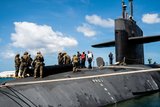
The HTS system will be installed on USN and USMC Landing Platform Dock vessels.
AMSC will make, test and deliver a shipset of components/materials; analyse configuration-based engineering change proposals; and provide vendor representative support during installation.
HTS degaussing system components and materials include a control unit, power modules, junction boxes, cryo-coolers, accumulation tanks, HTS degaussing cable assemblies and cold gas lines.
Work is scheduled for completion by September 2023.
Superconducting technology has the potential to reduce the size, weight, and cost of equipment such as degaussing systems, propulsion motors, and power electronics.
HTS cables offer major advantages over the conventional copper cables used to reduce the magnetic signatures of USN ships. A degaussing system utilising HTS cables would be smaller, lighter, and cost less to install than other systems.
As part of our promise to deliver comprehensive coverage to our Defence Insight and Premium News subscribers, our curated defence news content provides the latest industry updates, contract awards and programme milestones.

More from Naval Warfare
-
![US turns to allies to tackle navy shipbuilding backlog]()
US turns to allies to tackle navy shipbuilding backlog
A White House memorandum acknowledges US Navy shipbuilding backlogs and a weakened industrial base, opening a formal path for South Korean and Japanese yards to help rebuild capacity.
-
![US Navy’s $275 billion BBGN plan hinges on shipyard transformation]()
US Navy’s $275 billion BBGN plan hinges on shipyard transformation
The US Navy’s planned nuclear-powered warship carries a US$275 billion price tag, but the greater story lies in the industrial overhaul needed to build it, from AI-enabled design to digital twins and modular construction.
-
![Industry sees opportunity in Australia’s shift to networked undersea warfare]()
Industry sees opportunity in Australia’s shift to networked undersea warfare
Australia’s new defence innovation strategy indicates a shift from platform-centric to network-centric undersea warfare, with Ocius and Anduril Industries pointing to fast-growing opportunities for local industry.
-
![Asia-Pacific emerges as the largest export market for US-made USVs]()
Asia-Pacific emerges as the largest export market for US-made USVs
Asian customers have placed one of the largest known international purchases of US-built uncrewed surface vessels, highlighting accelerating regional demand for autonomous maritime capabilities and distributed naval operations.