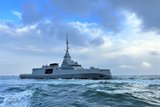
Three USN destroyers return from deployment


Three US Navy Arleigh-Burke-class guided-missile destroyers have returned to Norfolk Naval Station after a seven-month deployment to the US 6th and 5th Fleet areas of operations, which saw the vessels navigate more than 45,000 nautical miles.
The ships - USS Mason (DDG 87), USS Nitze (DDG 94), and USS Bainbridge (DDG 96) - deployed in April as part of Destroyer Squadron (DESRON) 2 and Carrier Strike Group (CSG) 12 that are supporting maritime stability and security.
‘Mason, Bainbridge and Nitze provided an adaptable and persistent force, adeptly accomplishing every mission we asked of them over multiple warfare areas,’ Capt Chris Follin, commodore of DESRON 2, said.
‘I’m incredibly proud of how our sailors performed during this rigorous deployment. They can return home knowing that they made a positive impact for maritime security in some of the most consequential waterways in the world.’
During their time in the 5th Fleet area of operations, the three destroyers took part in Operation Sentinel, ensuring the free flow of merchant vessels through the heavily-transited Strait of Hormuz.
Mason and Bainbridge also assisted the tanker Kokuka Courageous in June after it was attacked in the Gulf of Oman.
While in the 6th Fleet areas of operations, the three destroyers participated in dual carrier operations in the Mediterranean with the Abraham Lincoln CSG, which conducted training with the John C. Stennis CSG.
Multilateral training with regional partners and allies was also carried out, along with several port visits to ‘enhance relationships with partner nations’, the US Navy said.
Related Equipment in Defence Insight

More from Naval Warfare
-
![Kraken’s Royal Navy USV contract signals next step in crewed-uncrewed integration]()
Kraken’s Royal Navy USV contract signals next step in crewed-uncrewed integration
The UK Royal Navy’s rapid procurement of uncrewed platforms aligns with the force’s strategic shift towards a fleet better equipped to handle modern threats.
-
![HMS Anson’s milestone stay in Australia cut short during AUKUS deployment]()
HMS Anson’s milestone stay in Australia cut short during AUKUS deployment
The Astute-class submarine’s visit to Australia was the first time maintenance activity on a UK Royal Navy nuclear submarine had been carried out in the country.
-
![How Operation Epic Fury could reduce US readiness to face China]()
How Operation Epic Fury could reduce US readiness to face China
The offensive against Iran could impact training and maintenance cycles and accelerate the degradation of the US arsenal on top of depleting Washington’s stockpiles.
-
![UK Royal Navy explores modular counter-drone capabilities for future hybrid fleet]()
UK Royal Navy explores modular counter-drone capabilities for future hybrid fleet
The UK MoD is scoping out systems to counter the growing threat of uncrewed aerial systems, with a focus on low-cost modularity and speed to field.
-
![US Pentagon claims to have severely damaged Iranian capabilities, promises to increase attacks]()
US Pentagon claims to have severely damaged Iranian capabilities, promises to increase attacks
US military authorities claim to have sunk 20 Iranian vessels and destroyed Tehran’s Air Force, with the Pentagon making plans to send additional assets to the region.
-
![Greece’s newly commissioned FDI frigate deployed to Cyprus]()
Greece’s newly commissioned FDI frigate deployed to Cyprus
The recent naval modernisation efforts by the Hellenic Navy have been bolstered by the acquisition of advanced Naval Group frigates, the first of which was delivered in December 2025 and is now playing a crucial role in the latest Middle East conflict.