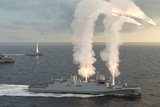
South Korea pushes forward on unmanned surface vessel development for future fleet
Hanwha’s 130t Combat USV is scheduled for development in the 2026–30 period, and it has an expected length of 35.46m. (Photo: Gordon Arthur)
South Korean industry continues to evolve unmanned surface vessels as the ROK Navy targets future force needs and addresses manpower challenges.


South Korea’s unmanned surface vessel (USV) sector is evolving rapidly, with multiple new designs under development as the Republic of Korea Navy (ROKN) looks to counter North Korean threats and address manpower shortages caused by declining birth rates.
A key driver of this effort is the Sea GHOST initiative (Guardian Harmonised with Operating manned Systems and Technology-based unmanned systems), launched by the ROKN in November 2022. This roadmap envisions a family of USVs, ranging from small reconnaissance craft to large, heavily armed combat USVs capable of launching loitering munition swarms, with the potential to replace fast attack craft in future
Our news & analysis is now part of Defence Insight®
A Basic-level or higher Defence Insight subscription is now required to view this content.


More from Naval Warfare
-
![How could Rheinmetall’s GMF 140 fit with ongoing programmes in North America?]()
How could Rheinmetall’s GMF 140 fit with ongoing programmes in North America?
With Canada committed to its River-class replacement and the USN pursuing a lower-cost frigate, Rheinmetall will need to demonstrate where the GMF 140 can fill a capability gap in the North American fleet.
-
![Australian industry programme builds pipeline for Virginia-class sustainment]()
Australian industry programme builds pipeline for Virginia-class sustainment
Australian businesses can now bid to support Virginia-class submarine sustainment in Western Australia, as momentum around the Henderson Defence Precinct also builds.
-
![South Korea, Japan and Turkey vie for US shipbuilding access in future frigate contest]()
South Korea, Japan and Turkey vie for US shipbuilding access in future frigate contest
Washington’s search for a foreign-built frigate could hand South Korea, Japan and Turkey a larger prize than a double-hull order: a foothold inside the US shipbuilding industrial base.
-
![Japan’s FY2027 budget bets on stand-off systems to offset demographic decline]()
Japan’s FY2027 budget bets on stand-off systems to offset demographic decline
Japan’s FY2027 defence budget backs stand-off strike, a 17-aircraft MQ-9B buy and a declared bid to lead the world in uncrewed maritime assets, alongside new frigates, submarines and support ships.