SM-6 interceptor undergoes ‘engage on remote’ tests


The Raytheon Standard Missile-6 (SM-6) interceptor has successfully intercepted targets in ‘engage on remote’ tests conducted as part of the US Navy’s Combat Ship System Qualification Trials.
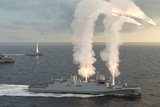
Conducted from USS Chancellorsville, the trial saw two SM-6 interceptors tested against anti-ship and cruise missile targets. The ship launched the SM-6 interceptors prior to its own radars ‘seeing’ the incoming threats, using targeting information from another Aegis ship in the area - the USS Sampson.
Raytheon reported that the first SM-6 intercepted a low-altitude, short-range supersonic target, while the second intercepted a low-altitude, medium-range subsonic target.
Mike Campisi, Standard Missile-6 senior program director, said: ‘Advanced warning and cueing from another sensor or ship allows the US Navy to take full advantage of SM-6’s over-the-horizon capability. Now the warfighter does not have to wait until the threat is knocking at the door to take it out. Targets are destroyed much sooner and one ship can defend a much larger area.’
SM-6 is designed to provide the US Navy with extended range protection against fixed- and rotary-wing aircraft, unmanned aerial vehicles and cruise missiles. The system uses both active and semi-active guidance modes and advanced fuzing techniques, and incorporates the signal processing and guidance control capabilities from the company’s Advanced Medium-Range Air-to-Air Missile.
More than 130 SM-6 interceptors have been delivered to the US Navy to date.

More from Naval Warfare
-
![Suppliers await next step in Australia’s mine warfare transition]()
Suppliers await next step in Australia’s mine warfare transition
Australia’s mine countermeasure capability remains in flux as the Huon-class nears retirement, but accelerated investment in autonomous systems is opening a path for industry.
-
![Can the US Navy ask Indo-Pacific allies to do more while training with them less?]()
Can the US Navy ask Indo-Pacific allies to do more while training with them less?
As the Iran War draws US ships and marine corps units away from the Indo-Pacific, curtailed exercises and a temporary carrier gap are exposing tensions between Washington’s demand for more self-reliant allies and the joint training needed to realise that ambition.
-
![How could Rheinmetall’s GMF 140 fit with ongoing programmes in North America?]()
How could Rheinmetall’s GMF 140 fit with ongoing programmes in North America?
With Canada committed to its River-class replacement and the USN pursuing a lower-cost frigate, Rheinmetall will need to demonstrate where the GMF 140 can fill a capability gap in the North American fleet.
-
![Australian industry programme builds pipeline for Virginia-class sustainment]()
Australian industry programme builds pipeline for Virginia-class sustainment
Australian businesses can now bid to support Virginia-class submarine sustainment in Western Australia, as momentum around the Henderson Defence Precinct also builds.
-
![South Korea, Japan and Turkey vie for US shipbuilding access in future frigate contest]()
South Korea, Japan and Turkey vie for US shipbuilding access in future frigate contest
Washington’s search for a foreign-built frigate could hand South Korea, Japan and Turkey a larger prize than a double-hull order: a foothold inside the US shipbuilding industrial base.