Sea Ceptor to arm Canadian Surface Combatant
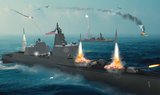
The vertical-launch Sea Ceptor air defence system. (Photo: MBDA)
MBDA will provide its Sea Ceptor air defence system for new Canadian frigates.


MBDA on 19 April announced a contract from Lockheed Martin Canada to equip Canadian Surface Combatant (CSC) frigates with the Sea Ceptor air defence weapon system.
Firing the Common Anti-air Modular Missile (CAMM), Sea Ceptor will undertake the close-in air defence role on the new CSC frigates for the Royal Canadian Navy.
MBDA claimed: ‘Sea Ceptor provides exceptional self-defence performance, with a rapid response time and a high rate of fire to defeat multiple threats simultaneously. Its state-of-the-art Soft Vertical Launch (SVL) technology enables full 360° coverage with close-range performance normally only associated with trainable launcher systems.’
Sea Ceptor will be integrated with the Combat Management System 330 (CMS 330) from Lockheed Martin Canada as part of a multi-tier air defence capability.
The CAMM missiles will be quad-packed in the Lockheed Extensible Launcher System, which is part of the Mk41 family of vertical launcher systems (VLSs). Shephard Defence Insight notes that the 15 planned CSC frigates will be armed with a 32-cell VLS.
As part of our promise to deliver comprehensive coverage to our Defence Insight and Premium News subscribers, our curated defence news content provides the latest industry updates, contract awards and programme milestones.
Related Programmes in Defence Insight
Canadian Surface Combatant/River Class (4-15) [Canada]
Canadian Surface Combatant/River Class (1-3) [Canada]
Related Equipment in Defence Insight

You may also like

More from Naval Warfare
-
![US Navy’s $275 billion BBGN plan hinges on shipyard transformation]()
US Navy’s $275 billion BBGN plan hinges on shipyard transformation
The US Navy’s planned nuclear-powered warship carries a US$275 billion price tag, but the greater story lies in the industrial overhaul needed to build it, from AI-enabled design to digital twins and modular construction.
-
![Industry sees opportunity in Australia’s shift to networked undersea warfare]()
Industry sees opportunity in Australia’s shift to networked undersea warfare
Australia’s new defence innovation strategy indicates a shift from platform-centric to network-centric undersea warfare, with Ocius and Anduril Industries pointing to fast-growing opportunities for local industry.
-
![Asia-Pacific emerges as the largest export market for US-made USVs]()
Asia-Pacific emerges as the largest export market for US-made USVs
Asian customers have placed one of the largest known international purchases of US-built uncrewed surface vessels, highlighting accelerating regional demand for autonomous maritime capabilities and distributed naval operations.
-
![RTX confirms US Marine Corps and US Navy acquire Hadalus UUV]()
RTX confirms US Marine Corps and US Navy acquire Hadalus UUV
RTX told Shephard that the Hadalus UUV has been procured by the US Marine Corps and the Office of Naval Research for operational experimentation as the company prepares additional demonstrations with the US Navy, NATO and AUKUS partners.
-
![The UK joins the movement towards joint procurement]()
The UK joins the movement towards joint procurement
The UK will spend an estimated US$3.89 billion over the next decade in joint naval programmes, a lot of which will be in cooperation with Norway.