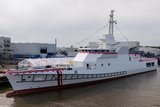
Russia’s newest frigate travels to Baltic Sea for final trial


The newest frigate to join the Russian Navy’s Northern Fleet, Project 22350 Admiral Kasatonov (pictured), has passed through the Great Belt Strait as it travels for further sea trials in the Baltic Sea.
This will mark the final stage of testing before it is handed over to the Navy. Previous trials have been underway since 20 November 2019.
These included tests of the missile armament in the White Sea and the firing of a Kalibr cruise missile at a land-based target. The ship can be armed with P-800 Oniks, Kalibr and Poliment-Redut missiles.
Admiral Kasatonov is the second Project 22350 frigate to be constructed by the Severnaya Shipyard which is a subsidiary of United Shipbuilding Corporation.
They are capable of reaching speeds of up to 29kts and have a total displacement of 4,500t.
Related Equipment in Defence Insight

You may also like

More from Naval Warfare
-
![Argentina’s submarine and frigate acquisitions resurface with $3.5bn funding plan]()
Argentina’s submarine and frigate acquisitions resurface with $3.5bn funding plan
Buenos Aires set out foreign loans worth $3.5 billion in its draft 2027 budget, opening a contest in which Naval Group and TKMS could lead the field.
-
![AUKUS heavyweight torpedo test raises questions over future armed UUV requirements]()
AUKUS heavyweight torpedo test raises questions over future armed UUV requirements
A heavyweight torpedo firing from the Royal Navy’s uncrewed submarine XV Excalibur suggests a shift beyond surveillance, with allied navies eyeing strike roles for large autonomous undersea vessels.
-
![Industrial teams prepare roadmap for Indonesia aircraft carrier transformation]()
Industrial teams prepare roadmap for Indonesia aircraft carrier transformation
Fincantieri and PT PAL have agreed on a framework to modernise the former Giuseppe Garibaldi, with drones, communications and broader Italian–Indonesian industrial ties involved.
-
![Five years on: where could opportunities emerge next for AUKUS Pillar II?]()
Five years on: where could opportunities emerge next for AUKUS Pillar II?
Payload commonality, combat systems and electronic warfare are emerging as likely priorities as the trilateral partnership balances building submarines with sharing industrial ecosystems.
-
![Singapore expands maritime presence with future-ready Sentinel OPV]()
Singapore expands maritime presence with future-ready Sentinel OPV
Singapore is building space for uncrewed systems and future technologies into its new Sentinel-class OPVs, reflecting a wider move towards adaptable vessels capable of maintaining persistent maritime presence.