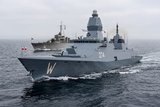
Royal Navy formally commissions HMS Forth


The Royal Navy has formally commissioned the first of its next-generation OPVs, HMS Forth, the navy announced on 13 April.
HMS Forth is the first of five new OPVs designed for counter-piracy, anti-smuggling, fishery protection, border patrol, counter terrorism and maritime defence operations. The vessel is classified as a Batch 2 River-class OPV, and her sisters – Trent, Medway, Tamar and Spey - are a significant upgrade on the original vessels that were designed and built 15 years ago.
HMS Forth will enter service in 2018, while the remaining four ships are all expected to arrive in Portsmouth by 2020.
Built by BAE Systems, HMS Forth is designed for a total crew of around 58, but requires only 34 to go to sea. The new OPVs are faster than their predecessors at 24 knots, have an increased range of 5,500 nautical miles, a 30mm automatic cannon as their main armament, two mini-guns, four machine-guns and are equipped with two Pacific 24 sea boats.
Each ship has an extended flight deck to operate up to Merlin size helicopters. They can accommodate up to 50 embarked Royal Marines for boarding and supporting operations ashore if required.
Related Equipment in Defence Insight


More from Naval Warfare
-
![Autonomy gives Turkey a chance to outflank established naval shipbuilders]()
Autonomy gives Turkey a chance to outflank established naval shipbuilders
Turkish shipbuilders have sold ships from Asia to Europe, but autonomy and swarm technology could give them a fairer fight against Western European rivals.
-
![Canada assesses security equipment changes for Polar Icebreaker Imnaryuaq]()
Canada assesses security equipment changes for Polar Icebreaker Imnaryuaq
The Canadian Department of National Defence is evaluating communications and reconnaissance changes for CCGS Imnaryuaq’s expanded maritime security role, while retaining its 2032 acceptance target.
-
![US Navy’s MQ-25 Stingray approaches carrier-integration tests]()
US Navy’s MQ-25 Stingray approaches carrier-integration tests
Boeing has outlined its upcoming precision-landing and carrier-airspace trials as MQ-25 manufacturing shifts towards Illinois, with initial Lot 1 deliveries expected in 2029.
-
![From Poland to the Pacific: can Miecznik become a blueprint for other navies?]()
From Poland to the Pacific: can Miecznik become a blueprint for other navies?
Babcock is taking its Polish industrial partnership approach to Denmark and New Zealand as navies seek sovereign shipbuilding skills alongside ships.