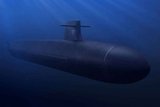
Italy’s U212 Near Future Submarine production builds pace as upgrade plans mature
NFS 1 is currently 52.6% through its production, as part of Italy's U212 Near Future Submarine (NFS) programme which now addresses a total of four submarines. (Photo: OCCAR)
Andrea Simone Pinna, OCCAR-EA combat system officer for the U212 NFS programme, outlined production progress, new capabilities and plans for the Italian Navy’s next-generation conventional submarine.


Italy’s U212 Near Future Submarine (NFS) programme is advancing through production, with four boats now under construction at Fincantieri’s Muggiano shipyard and a suite of future capability upgrades – including deep strike, covert mining and special forces integration – taking shape on the programme’s horizon.
Andrea Simone Pinna, combat system officer for the U212 NFS programme division at the Organisation for Joint Armament Cooperation (OCCAR), provided an update on the programme during a presentation at UDT 2026 in London on 15 April 2026.
Speaking on behalf of the programme manager, Capt Decio Trinca, Pinna outlined the programme’s production, while simultaneously
Our news & analysis is now part of Defence Insight®
A Basic-level or higher Defence Insight subscription is now required to view this content.

More from Naval Warfare
-
![Competitive P17B tender marks a shift in Indian Navy frigate procurement]()
Competitive P17B tender marks a shift in Indian Navy frigate procurement
The Indian Navy's P17B programme is expected to combine greater weapons capacity with a competitive domestic construction model, although key systems could remain dependent on international supply chains.
-
![How France’s SNLE 3G programme is reshaping the naval nuclear industrial base]()
How France’s SNLE 3G programme is reshaping the naval nuclear industrial base
Extending far beyond a four-submarine replacement programme, France’s ballistic missile submarine effort is a decades-long industrial initiative designed to preserve the country’s ability to build and sustain nuclear-powered strategic platforms.
-
![Quantum Systems enters maritime domain with Baltic-focused USV and UUV]()
Quantum Systems enters maritime domain with Baltic-focused USV and UUV
Quantum Systems has launched into the maritime domain with Seavex and Subvex, aiming to close a Baltic Sea ISR gap opened by infrastructure sabotage.
-
![China’s mineral processing dominance exposes naval supply chain vulnerabilities]()
China’s mineral processing dominance exposes naval supply chain vulnerabilities
Competition for critical minerals, and China’s dominance of their processing, is emerging as a decisive factor in future naval procurement programmes.