Royal Australian Navy sizes up modernisation plans for new and existing capabilities
Australia’s Collins-class submarines will start undergoing a Life-of-Type Extension programme in 2026. (Photo: Australian Defence Force)
The Australian navy is pushing ahead with its efforts to modernise its workforce and capabilities while balancing risky submarine upgrades, ageing Collins-class boats and a shrinking minehunter fleet. Head of navy capability RAdm Stephen Hughes updated Shephard on the force’s progress.


The Royal Australian Navy (RAN) is undergoing a major transformation. A bevy of new platforms is coming, including upgraded Mogami frigates, Hunter-class frigates and nuclear-powered submarines. At the same time, however, the navy must manage and refresh existing capabilities.
On underwater capabilities, the RAN will not receive second-hand Virginia-class submarines from the US before 2032, and it is hoped SSN-AUKUS submarines will arrive in the early 2040s. To tide the RAN over, it needs to keep its fleet of Collins-class submarines viable, which it aims to achieve by performing a Life-of-Type Extension (LOTE) programme on Collins-class boats commissioned from 1996-2003.
RAdm Stephen Hughes, the RAN’s head of navy capability, acknowledged to Shephard that the LOTE and SSN projects are high-risk. “At the moment, we’ve about 160-200 people in the US and UK nuclear pipelines,” he pointed out. “If you think about that, that’s like two or three Collins’ worth of people in that system. But at the same time, we’re delivering Collins capability.”
Related Articles
Royal Australian Navy’s plan for fleet refresh continues in the face of headwinds
AUKUS update: Australian sovereignty is “paramount” as Trump declares “full steam ahead”
Hughes added: “Now all eyes are on Collins moving forward and the transitioning. The LOTE is an important part of that, and that’s technically complex. It’s not beyond the wit of man to be able to do it, but it requires that balance between workforce and industry, building capability for the nuclear submarines, and at the same time keeping Collins going.”
The RAN has given options to the government on how to proceed with the LOTE, and is awaiting Canberra’s decision. “From a technical perspective, we have two courses of action and a whole bunch of subsets of that...[but] I think you’ll find that the path that we’re recommending will deliver them the capability effect they need.”
The LOTE will be tailored to each submarine’s condition, and the extent of work required on each boat will likely not be known until each one enters its two-year maintenance period. Nonetheless, Hughes confirmed HMAS Farncomb will be the first to enter the LOTE in 2026.
He promised: “We’re not going to compromise the Collins capability under any circumstances…It’s the thing that we can put out into the region and provides us a significant deterrence around an adversary’s sea-based manoeuvre.”
Continuous reinvestment in mine countermeasures
Last year, Australia suspended the Project Sea 1905 mine countermeasures (MCM) modernisation effort. The RAN has just two Huon-class minehunters remaining, and multiple industry sources believe an MCM capability gap has emerged.
Hughes denied this, saying “the current capability we have at the moment meets minimal viable capability”. He explained the government did not technically cancel Sea 1905, but delayed it, and that it would be addressed in the early 2030s.
As minehunters are paid off, “how do I take those resources and releases – whether it’s dollars, workforce – and then rapidly replace them within that resource envelope with an equivalent minimal viable capability?” Hughes remarked.
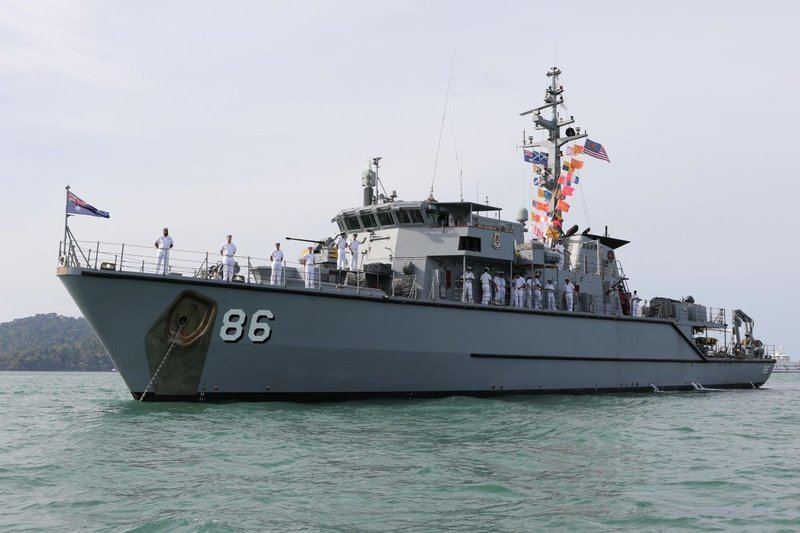
“It might be autonomous systems, it might be remote systems or it might be a deployable capability that I stick on the back of an Arafura offshore patrol vessel or on the back of some other vessels which we’re getting through other processes – small utility craft – and then I’ve got to transition the workforce onto that.”
Hughes pointed out he is “in the process of working with some industry partners around what that roadmap looks like”. In the meantime, he said to expect “an ever-greening, rolling cycle of reinvesting” in MCM.
The head of navy capability rejected the argument that SSNs soaking up large amounts of funds are causing other areas such as MCM to suffer. “It’s got to come down to priorities of the government,” he insisted. “My view is, sure, if there was all the money in the world, we could do everything.”
He pointed to generous investments in Naval Strike Missiles (NSM), SM-6s and Tomahawks, for example, and said the government has already approved A$42 billion (US$28 billion) in maritime domain spending since assuming his post in December 2022.
Upgraded Mogami coming in 2029
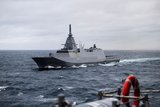
One of Hughes’ priorities is the arrival of upgraded Mogami-class frigates from Japan. “My real focus now is that we’ve literally got three to four years before we catch the first of those ships, which will be delivered in 2029…So for navy capabilities, how do we transition out of the Anzacs? How do we create the crews we need for the Mogami?”
One Anzac frigate has been retired already, and a second was to be decommissioned in 2026. However, Hughes shared: “Recently, the intent is most probably to keep seven running through to the Mogami, and then one will go as the new Mogami arrives.”
The head of navy capability said the upgraded Mogami was bigger, more capable and would offer a greater availability of 300 days per year. In Australian service they will carry ESSM Block 2 and NSM missiles, SeaRAM and Mk 54 torpedo-armed MH-60R helicopters.
He concluded: “In terms of what the upgraded Mogami will bring the RAN, I’ll be honest – it’s going to be a game-changer from a capability perspective.”
Related Programmes in Defence Insight
Project SEA 3000 (1-3) [Australia]
Related Equipment in Defence Insight


More from Naval Warfare
-
![Japan’s FY2027 budget bets on stand-off systems to offset demographic decline]()
Japan’s FY2027 budget bets on stand-off systems to offset demographic decline
Japan’s FY2027 defence budget backs stand-off strike, a 17-aircraft MQ-9B buy and a declared bid to lead the world in uncrewed maritime assets, alongside new frigates, submarines and support ships.
-
![Russia’s uncrewed boat portfolio hints at future naval demand]()
Russia’s uncrewed boat portfolio hints at future naval demand
Ukrainian intelligence has catalogued more than 20 Russian uncrewed surface vessels, revealing a portfolio weighted towards mine warfare and logistics, with implications for Western naval investment.
-
![Ukraine’s new long-range 12m autonomous vessel can deploy other drones]()
Ukraine’s new long-range 12m autonomous vessel can deploy other drones
Ukraine’s UForce unveiled the MV11 uncrewed surface vessel, designed to launch and support other naval drones at sea, fuelling debate over the future of autonomous maritime task groups.