Raytheon tests rocket motor for MAD-FIRES interceptor
Raytheon has successfully tested a hot fire rocket motor for DARPA’s Multi-Azimuth Defense Fast Intercept Round Engagement System (MAD-FIRES), the company announced on 6 May.
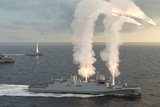
The MAD-FIRES interceptor has been designed to provide US Navy ships with the ability to defend themselves against multiple wave threats such as anti-ship missiles and UAS.
If fielded, the capability will combine the speed, rapid fire and depth of a gun weapon system with the precision and accuracy of guided missiles.
Thomas Bussing, VP, Raytheon Advanced Missile Systems, said: ‘The navy is asking for leading-edge capabilities that can take out rapidly approaching targets, and Raytheon’s interceptor for the MAD-FIRES programme will deliver. This test shows Raytheon is right on track to provide an affordable, advanced technology to the fleet.’






More from Naval Warfare
-
![Quantum Systems enters maritime domain with Baltic-focused USV and UUV]()
Quantum Systems enters maritime domain with Baltic-focused USV and UUV
Quantum Systems has launched into the maritime domain with Seavex and Subvex, aiming to close a Baltic Sea ISR gap opened by infrastructure sabotage.
-
![Suppliers await next step in Australia’s mine warfare transition]()
Suppliers await next step in Australia’s mine warfare transition
Australia’s mine countermeasure capability remains in flux as the Huon-class nears retirement, but accelerated investment in autonomous systems is opening a path for industry.
-
![Can the US Navy ask Indo-Pacific allies to do more while training with them less?]()
Can the US Navy ask Indo-Pacific allies to do more while training with them less?
As the Iran War draws US ships and marine corps units away from the Indo-Pacific, curtailed exercises and a temporary carrier gap are exposing tensions between Washington’s demand for more self-reliant allies and the joint training needed to realise that ambition.
-
![How could Rheinmetall’s GMF 140 fit with ongoing programmes in North America?]()
How could Rheinmetall’s GMF 140 fit with ongoing programmes in North America?
With Canada committed to its River-class replacement and the USN pursuing a lower-cost frigate, Rheinmetall will need to demonstrate where the GMF 140 can fill a capability gap in the North American fleet.
-
![Australian industry programme builds pipeline for Virginia-class sustainment]()
Australian industry programme builds pipeline for Virginia-class sustainment
Australian businesses can now bid to support Virginia-class submarine sustainment in Western Australia, as momentum around the Henderson Defence Precinct also builds.