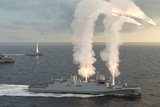
Raytheon contracted to support close-in weapon systems


Raytheon has been awarded $246.5 million for performance-based logistics for the land-based Phalanx and Rolling Airframe Missile (RAM)/SeaRAM close-in weapon systems.
It will cover the repair, upgrade, or replacement of the systems, as well as inventory and obsolescence management.
The contract includes a two-year base period with one three-year option, which if exercised will bring the contract ceiling value to $466.4 million.
Work will be performed in Louisville, Kentucky, and is expected to be completed by August 2021, or three years after that if the option is exercised.
Navy annual working capital funds will be obligated as individual task orders are issued, and funds will not expire at the end of the current fiscal year.
Naval Supply Systems Command, Weapon Systems Support, Philadelphia, Pennsylvania, is the contracting activity for the award.
Related Equipment in Defence Insight

More from Naval Warfare
-
![Can the US Navy ask Indo-Pacific allies to do more while training with them less?]()
Can the US Navy ask Indo-Pacific allies to do more while training with them less?
As the Iran War draws US ships and marine corps units away from the Indo-Pacific, curtailed exercises and a temporary carrier gap are exposing tensions between Washington’s demand for more self-reliant allies and the joint training needed to realise that ambition.
-
![How could Rheinmetall’s GMF 140 fit with ongoing programmes in North America?]()
How could Rheinmetall’s GMF 140 fit with ongoing programmes in North America?
With Canada committed to its River-class replacement and the USN pursuing a lower-cost frigate, Rheinmetall will need to demonstrate where the GMF 140 can fill a capability gap in the North American fleet.
-
![Australian industry programme builds pipeline for Virginia-class sustainment]()
Australian industry programme builds pipeline for Virginia-class sustainment
Australian businesses can now bid to support Virginia-class submarine sustainment in Western Australia, as momentum around the Henderson Defence Precinct also builds.
-
![South Korea, Japan and Turkey vie for US shipbuilding access in future frigate contest]()
South Korea, Japan and Turkey vie for US shipbuilding access in future frigate contest
Washington’s search for a foreign-built frigate could hand South Korea, Japan and Turkey a larger prize than a double-hull order: a foothold inside the US shipbuilding industrial base.