Project Biro makes headway in South Africa with second MMIPV launch
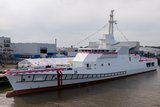
A second MMIPV has joined first-in-class King Sekhukhune II (pictured). (Photo: SAN)
With two MMIPVs in the water, the South African Navy awaits the final vessel in 2024.


The second of three Multi-Mission Inshore Patrol Vessels (MMIPVs) for the South African Navy (SAN) was launched on 14 October.
Shipbuilder Damen Shipyards Cape Town (DSCT) noted in a statement that the vessel will be delivered to the SAN in 2023 ‘after extensive acceptance trials’, and the final MMIPV will follow in 2024.
DSCT delivered the first MMPIV (King Sekhukhune II) in May 2022, four years after it was awarded the Project Biro contract.
Each MMPIV is 62m long with a beam of 11m, based on the Damen Sea Axe design.
Shephard Defence Insight estimates a unit cost of $33 million per vessel.
Related Programmes in Defence Insight
Project Biro-62m Multimission Inshore Patrol Vessels (MMIPVs)
Related Equipment in Defence Insight


More from Naval Warfare
-
![Five years on: where could opportunities emerge next for AUKUS Pillar II?]()
Five years on: where could opportunities emerge next for AUKUS Pillar II?
Payload commonality, combat systems and electronic warfare are emerging as likely priorities as the trilateral partnership balances building submarines with sharing industrial ecosystems.
-
![From the Baltic to the Gulf: where USV procurement is heading next]()
From the Baltic to the Gulf: where USV procurement is heading next
Saildrone’s new Copenhagen base is one sign of a larger shift, as navies globally turn to uncrewed vessels for surveillance and mine clearance.
-
![Israeli Navy looks to expand as war reshapes future force requirements]()
Israeli Navy looks to expand as war reshapes future force requirements
Israel’s navy is preparing for a larger and more technically diverse role, but its ambitions could be impacted by supply chain restrictions, accelerating demand for domestic naval production as well as autonomous maritime capabilities.
-
![Quantum sensing gathers pace as navies eye undersea advantage]()
Quantum sensing gathers pace as navies eye undersea advantage
As AI dominates defence conversations, industry increasingly points to quantum sensing as the technology set to change submarine and uncrewed underwater vehicle operations.