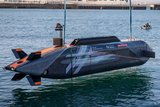
Pioneer USV to begin sea trials this year
The Pioneer USV measures 14m in length. (Photo: ACUA Ocean)
The Pioneer USV is being built for ACUA Ocean at Aluminium Marine Consultants (AMC) in the UK on the Isle of Wight. ACUA has also been developing the larger Maelstrom USV.


UK company ACUA Ocean has outlined details of its modular small water-plane twin hull (SWATH) 14m Pioneer USV and plans for its long-endurance high-powered 24m Maelstrom USV.
The Pioneer-class USVs feature a hybrid-electric propulsion system and can use a gaseous hydrogen or a low-emission diesel powertrain dependent on end-user specifications or mission parameters.
Evaluation has included wave tank testing and digital simulations which, according to the company, has demonstrated Pioneer-class USVs outperforming the seakeeping stability of a monohull vessel three-times its length and 10-times its displacement.
The platform SWATH’s design supports both modularity of build and also the deployment of modular sensor and system payloads.
Pioneer builds on the company’s H-USV which can carry a payload of 4t with 20ft ISO mounts for modular sensors supported by 1kW continuous power.
In addition to the Pioneer, ACUA is developing Maelstrom which is designed to deliver enhanced and scalable capabilities for a range of defence and commercial customers.
Pioneer is scheduled to commence sea trials before the end of the year and Maelstrom is scheduled to enter service in 2026.



More from Naval Warfare
-
![Canada assesses security equipment changes for Polar Icebreaker Imnaryuaq]()
Canada assesses security equipment changes for Polar Icebreaker Imnaryuaq
The Canadian Department of National Defence is evaluating communications and reconnaissance changes for CCGS Imnaryuaq’s expanded maritime security role, while retaining its 2032 acceptance target.
-
![US Navy’s MQ-25 Stingray approaches carrier-integration tests]()
US Navy’s MQ-25 Stingray approaches carrier-integration tests
Boeing has outlined its upcoming precision-landing and carrier-airspace trials as MQ-25 manufacturing shifts towards Illinois, with initial Lot 1 deliveries expected in 2029.
-
![From Poland to the Pacific: can Miecznik become a blueprint for other navies?]()
From Poland to the Pacific: can Miecznik become a blueprint for other navies?
Babcock is taking its Polish industrial partnership approach to Denmark and New Zealand as navies seek sovereign shipbuilding skills alongside ships.