Norway orders additional Naval Strike Missiles
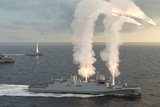
Norway has ordered more Naval Strike Missiles. (Photo: Kongsberg)
Kongsberg will supply more missiles for Norwegian surface ships and extend the lifespan of the existing Norwegian NSM arsenal.


The Royal Norwegian Navy is receiving more Naval Strike Missiles (NSMs) from Kongsberg Defence & Aerospace.
Under two deals from the Norwegian Defence Materiel Agency (FMA) with a total value of NOK1.43 billion ($170.3 million), Kongsberg will provide a new batch of NSMs for surface vessels and the company will also extend the life of the existing Norwegian NSM inventory.
‘The existing inventory of missiles will go through a series of maintenance actions to extend their operational timeline and continue providing state of the art defence capabilities for the Navy,’ Kongsberg announced in a 29 October statement.
Øyvind Kolset, EVP of Kongsberg Defense & Aerospace, said: ‘Contracts such as this support Kongsberg’s and FMA’s sustainability goals, and helps to secure further employment, not only for our employees, but also for our national subcontractors. We cannot produce nor deliver such advanced and state-of-the art products alone.’
NSM already arms Fridtjof Nansen-class frigates and Skjold-class corvettes, and it will also be installed aboard four new Type 212CD submarines on order for the Norwegian Navy from ThyssenKrupp Marine Systems.
Related Equipment in Defence Insight

You may also like

More from Naval Warfare
-
![How could Rheinmetall’s GMF 140 fit with ongoing programmes in North America?]()
How could Rheinmetall’s GMF 140 fit with ongoing programmes in North America?
With Canada committed to its River-class replacement and the USN pursuing a lower-cost frigate, Rheinmetall will need to demonstrate where the GMF 140 can fill a capability gap in the North American fleet.
-
![Australian industry programme builds pipeline for Virginia-class sustainment]()
Australian industry programme builds pipeline for Virginia-class sustainment
Australian businesses can now bid to support Virginia-class submarine sustainment in Western Australia, as momentum around the Henderson Defence Precinct also builds.
-
![South Korea, Japan and Turkey vie for US shipbuilding access in future frigate contest]()
South Korea, Japan and Turkey vie for US shipbuilding access in future frigate contest
Washington’s search for a foreign-built frigate could hand South Korea, Japan and Turkey a larger prize than a double-hull order: a foothold inside the US shipbuilding industrial base.
-
![Japan’s FY2027 budget bets on stand-off systems to offset demographic decline]()
Japan’s FY2027 budget bets on stand-off systems to offset demographic decline
Japan’s FY2027 defence budget backs stand-off strike, a 17-aircraft MQ-9B buy and a declared bid to lead the world in uncrewed maritime assets, alongside new frigates, submarines and support ships.
-
![Russia’s uncrewed boat portfolio hints at future naval demand]()
Russia’s uncrewed boat portfolio hints at future naval demand
Ukrainian intelligence has catalogued more than 20 Russian uncrewed surface vessels, revealing a portfolio weighted towards mine warfare and logistics, with implications for Western naval investment.
-
![Ukraine’s new long-range 12m autonomous vessel can deploy other drones]()
Ukraine’s new long-range 12m autonomous vessel can deploy other drones
Ukraine’s UForce unveiled the MV11 uncrewed surface vessel, designed to launch and support other naval drones at sea, fuelling debate over the future of autonomous maritime task groups.