Northrop demos AQS-24B mine hunting system
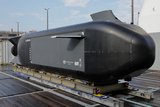
Northrop Grumman has successfully demonstrated the AQS-24B mine hunting system’s ability to perform synthetic aperture sonar processing at 18 knots in real time in a US Navy field test, the company announced on 14 September.
The test was conducted in May at the US Navy Central Command in Bahrain. According to the company, the system successfully executed the 12 missions it was tasked to perform during the test.
The AQS-24B enhanced mine hunting sonar is designed to detect, classify and localise modern-day mine threats, with improved image resolution and real-time sonar processing.
During separate tactics development trials in Panama City, Florida, the AQS-24B achieved a record long single sortie tow duration of 16.25 hours from a surface ship.
Alan Lytle, vice president, undersea systems business unit, Northrop Grumman, said: ‘The AQS-24B represents a significant advancement of the US Navy’s mine hunting capability, on both the MH-53E helicopters as well as the Mine Hunting Unmanned Surface Vessels.
‘With the AQS-24B, Northrop Grumman and the navy have worked together to effectively advance the state of the art in undersea synthetic aperture sonar.’



More from Naval Warfare
-
![US turns to allies to tackle navy shipbuilding backlog]()
US turns to allies to tackle navy shipbuilding backlog
A White House memorandum acknowledges US Navy shipbuilding backlogs and a weakened industrial base, opening a formal path for South Korean and Japanese yards to help rebuild capacity.
-
![US Navy’s $275 billion BBGN plan hinges on shipyard transformation]()
US Navy’s $275 billion BBGN plan hinges on shipyard transformation
The US Navy’s planned nuclear-powered warship carries a US$275 billion price tag, but the greater story lies in the industrial overhaul needed to build it, from AI-enabled design to digital twins and modular construction.
-
![Asia-Pacific emerges as the largest export market for US-made USVs]()
Asia-Pacific emerges as the largest export market for US-made USVs
Asian customers have placed one of the largest known international purchases of US-built uncrewed surface vessels, highlighting accelerating regional demand for autonomous maritime capabilities and distributed naval operations.