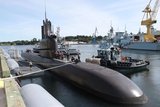
New Naval Security Team for RCN


The Royal Canadian Navy has announced plans to form a Naval Security Team (NST) to enhance the safety and security of its ships and personnel while on deployment.
The team is being formed to help relieve the force protection burden placed on a ship’s company when deployed, leaving crew to focus on their key mission set.
The NST will be composed primarily of naval reservists and will include a full-time command team to ensure personnel, training and equipment are available for deployment.
The 30-50 personnel strong team will provide port force protection and host nation liaison, along with supporting intelligence requirements in foreign ports.
Training of the team will be tailored to meet specific mission requirements; namely use of force, rules of engagement training, more advanced weapons training, small boat tactics, communications, deployed logistics and liaison skills.
Commander Jeffrey White, Officer-in-Charge of the NST concept, said: ‘The NST starts with a command and support cell, and then has other teams attached like Lego blocks as the mission dictates. These attached layers will include a security or ‘force protection’ section, a tactical boat section, a mobile repair team and intelligence support.’
The inaugural NST will be deployed in the Spring/Summer of 2017 to support ships as part of Westploy, an operation aimed at building strong ties between the RCN and the navies of Asia-Pacific countries, while also promoting peace and security in the Pacific region.


More from Naval Warfare
-
![The UK joins the movement towards joint procurement]()
The UK joins the movement towards joint procurement
The UK will spend an estimated US$3.89 billion over the next decade in joint naval programmes, a lot of which will be in cooperation with Norway.
-
![Rheinmetall’s GMF 140: Ambitious frigate or market misfit?]()
Rheinmetall’s GMF 140: Ambitious frigate or market misfit?
Rheinmetall has unveiled its first next-generation frigate design, showing ambitions to compete as a surface combatant prime contractor. While the company is targeting North America, analysts believe the concept may be better positioned for future European programmes.
-
![US Navy $76.6bn award provides stability for submarine production]()
US Navy $76.6bn award provides stability for submarine production
The US Department of War’s US$76.6 billion Columbia-and Virginia-class submarine contract gives industry demand certainty as Washington seeks to rebuild its shipbuilding base.
-
![Dreadnought Phase 4 opens £2.5 billion supply chain opportunity]()
Dreadnought Phase 4 opens £2.5 billion supply chain opportunity
The UK government’s £8.4 billion Dreadnought Phase 4 investment sets aside £2.5 billion for the wider submarine supply chain, opening new work beyond BAE Systems’ prime contract.
-
![Hanwha Ocean deepens US ties and eyes Saudi submarine prospect after Canada setback]()
Hanwha Ocean deepens US ties and eyes Saudi submarine prospect after Canada setback
Hanwha Ocean is deepening ties with the US and eyeing a submarine opportunity in Saudi Arabia, as South Korea looks to convert its Canadian defeat into export momentum.