Naval Group launches third Argentinian OPV
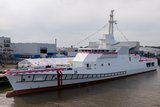
The third of the four Offshore Patrol Vessel 87 (OPV 87) ordered to Naval Group by Argentina has been launched at Concarneau shipyard (Brittany). (Photo: Naval Group)
Naval Group launches the third OPV ordered by Argentina, ARA Storni.


Naval Group launched ARA Storni on 10 May as the third of four Argentinian OPV 87 vessels.
The delivery is part of the contract between Naval Group and Argentina to provide four multi-mission offshore patrol vessels (OPVs). ARA Bouchard was delivered in December 2019 and ARA Piedrabuena followed in April 2021.
ARA Storni will offer the same assets and characteristics as the ARA Piedrabuena. It is better armed than the ARA Bouchard, more motorised, equipped with an active stabilisation system, bow thruster and is adapted to cold-water navigation, such as around Antarctica.
The Argentinian OPVs benefit from innovations developed by Naval Group and proven by the French Navy.
It features high endurance and seaworthiness, 360˚ visibility from the bridge, a unique mast for a panoramic radar coverage and a ramp system at the bow for rapid deployment of fast crafts or SF.
The ARA Storni is equipped with the Polaris system and NiDL tactical data link.
The vessel can stay in deep-sea environments for more than three weeks. It can reach a speed of 20kt and has a reduced crew size of 40 people.
The vessel has space on board for a helicopter and around 20 additional passengers.
Related Equipment in Defence Insight


More from Naval Warfare
-
![From the Baltic to the Gulf: where USV procurement is heading next]()
From the Baltic to the Gulf: where USV procurement is heading next
Saildrone’s new Copenhagen base is one sign of a larger shift, as navies globally turn to uncrewed vessels for surveillance and mine clearance.
-
![Quantum sensing gathers pace as navies eye undersea advantage]()
Quantum sensing gathers pace as navies eye undersea advantage
As AI dominates defence conversations, industry increasingly points to quantum sensing as the technology set to change submarine and uncrewed underwater vehicle operations.
-
![Competitive P17B tender marks a shift in Indian Navy frigate procurement]()
Competitive P17B tender marks a shift in Indian Navy frigate procurement
The Indian Navy's P17B programme is expected to combine greater weapons capacity with a competitive domestic construction model, although key systems could remain dependent on international supply chains.
-
![How France’s SNLE 3G programme is reshaping the naval nuclear industrial base]()
How France’s SNLE 3G programme is reshaping the naval nuclear industrial base
Extending far beyond a four-submarine replacement programme, France’s ballistic missile submarine effort is a decades-long industrial initiative designed to preserve the country’s ability to build and sustain nuclear-powered strategic platforms.