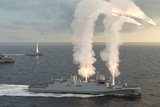
MBDA succeeds in first trial firing of Sea Venom


MBDA has carried out its first qualification firing trial for the Sea Venom/ANL anti-ship missile. The test was carried out at the DGA Essais de missiles test site at Ile Du Levant.
The missile was launched from a Dauphin helicopter and it managed to reach its cruise speed whilst sea skimming at an extremely low altitude.
Previous tests such as the lock on after launch (LOAL) and the lock on before launch (LOBL) have already been completed.
Sea Venom is being developed for British and French naval helicopters for use against hostile vessels in littoral environments.
The new missile is expected to be used by the UK RN’s AW159 Wildcat and the French Navy’s Guépard Light Joint Helicopter (HIL).
Related Equipment in Defence Insight



More from Naval Warfare
-
![Quantum Systems enters maritime domain with Baltic-focused USV and UUV]()
Quantum Systems enters maritime domain with Baltic-focused USV and UUV
Quantum Systems has launched into the maritime domain with Seavex and Subvex, aiming to close a Baltic Sea ISR gap opened by infrastructure sabotage.
-
![Suppliers await next step in Australia’s mine warfare transition]()
Suppliers await next step in Australia’s mine warfare transition
Australia’s mine countermeasure capability remains in flux as the Huon-class nears retirement, but accelerated investment in autonomous systems is opening a path for industry.
-
![Can the US Navy ask Indo-Pacific allies to do more while training with them less?]()
Can the US Navy ask Indo-Pacific allies to do more while training with them less?
As the Iran War draws US ships and marine corps units away from the Indo-Pacific, curtailed exercises and a temporary carrier gap are exposing tensions between Washington’s demand for more self-reliant allies and the joint training needed to realise that ambition.
-
![How could Rheinmetall’s GMF 140 fit with ongoing programmes in North America?]()
How could Rheinmetall’s GMF 140 fit with ongoing programmes in North America?
With Canada committed to its River-class replacement and the USN pursuing a lower-cost frigate, Rheinmetall will need to demonstrate where the GMF 140 can fill a capability gap in the North American fleet.
-
![Australian industry programme builds pipeline for Virginia-class sustainment]()
Australian industry programme builds pipeline for Virginia-class sustainment
Australian businesses can now bid to support Virginia-class submarine sustainment in Western Australia, as momentum around the Henderson Defence Precinct also builds.