Japanese navy appoints first female chief of warship unit


The Japanese navy said on 6 March it had for the first time appointed a woman as commander of a unit that includes the country’s biggest warship.
Ryoko Azuma, 44, will command four warships making up a division with a total of 1,000 crew members.
A spokesman for the Japan Maritime Self-Defense Force told AFP: ‘This is the first time a woman was appointed for the job. But she wasn’t chosen because she was a woman.’
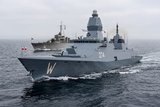
The ships include the helicopter carrier Izumo, the navy’s biggest ship.
Azuma, after a ceremony at Yokohama near Tokyo to mark her arrival in the post, said: ‘I want to do my best to carry out the heavy duty I have been given.’
About 400 crew members attended the ceremony.
Azuma said: ‘I don’t think about being a woman but I want to try to become a role model for younger female officers.’
About 14,000 women are currently serving in the Self-Defense Forces as the military is known, accounting for only 6% of the entire personnel.
On most levels, Japan lags behind other developed countries in terms of sexual equality.
In politics women are still under-represented with only 47 of the 465 members of the lower house.
According to statistics compiled by the Swiss-based Inter-Parliamentary Union, this ratio of 10.1% places Japan below Myanmar and Gambia.


More from Naval Warfare
-
![Canada assesses security equipment changes for Polar Icebreaker Imnaryuaq]()
Canada assesses security equipment changes for Polar Icebreaker Imnaryuaq
The Canadian Department of National Defence is evaluating communications and reconnaissance changes for CCGS Imnaryuaq’s expanded maritime security role, while retaining its 2032 acceptance target.
-
![US Navy’s MQ-25 Stingray approaches carrier-integration tests]()
US Navy’s MQ-25 Stingray approaches carrier-integration tests
Boeing has outlined its upcoming precision-landing and carrier-airspace trials as MQ-25 manufacturing shifts towards Illinois, with initial Lot 1 deliveries expected in 2029.
-
![From Poland to the Pacific: can Miecznik become a blueprint for other navies?]()
From Poland to the Pacific: can Miecznik become a blueprint for other navies?
Babcock is taking its Polish industrial partnership approach to Denmark and New Zealand as navies seek sovereign shipbuilding skills alongside ships.
-
![Unsettled waters in the North: can navies still trust their Arctic acoustic maps?]()
Unsettled waters in the North: can navies still trust their Arctic acoustic maps?
The changing Arctic environment is creating new challenges for submarine detection, driving demand for distributed sensors, uncrewed underwater vehicles and real-time acoustic modelling.