Italian future submarine programme takes a step forward
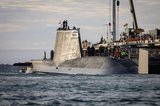
Initial components of the first U212NFS submarine, pictured on 11 January. (Photo: Fincantieri)
Construction is underway of the first U212NFS submarine for the Italian Navy.


The U212 Near Future Submarine (NFS) programme for the Italian Navy passed a milestone on 11 January when Fincantieri began production of the first boat at the Muggiano shipyard in La Spezia.
The U212 NFS constitutes a radical evolution compared to the U-212A and marks the return of Italy to sovereign production of submarines, according to Shephard Defence Insight.
In February 2021, Fincantieri and OCCAR signed a €1.35 billion ($1.63 billion) contract to build two U212NFS diesel-electric submarines (plus two more boats on option) with deliveries scheduled for late 2027 and early 2029.
The U212 NFS will be slightly longer than the Todaro-class Type 212A boats in service with the Italian Navy, and they will feature new lithium-ion batteries instead of lead-acid batteries.
Other notable features include air independent propulsion and a Leonardo-developed combat management system.
The new submarines are designed to be integrated within the Italian Carrier Strike Group for force projection duties and to carry out intelligence, ISR and special operations.
Each boat will be capable of carrying long-range cruise missiles (possibly Teseo MK2/E, Tomahawk or Scalp Naval) and Black Shark Advanced heavy torpedoes.
Related Programmes in Defence Insight
U-212 Near Future Submarine (4) [Italy]
U-212 Near Future Submarine (1-2) [Italy]
Related Equipment in Defence Insight

You may also like

More from Naval Warfare
-
![Industrial teams prepare roadmap for Indonesia aircraft carrier transformation]()
Industrial teams prepare roadmap for Indonesia aircraft carrier transformation
Fincantieri and PT PAL have agreed on a framework to modernise the former Giuseppe Garibaldi, with drones, communications and broader Italian–Indonesian industrial ties involved.
-
![Five years on: where could opportunities emerge next for AUKUS Pillar II?]()
Five years on: where could opportunities emerge next for AUKUS Pillar II?
Payload commonality, combat systems and electronic warfare are emerging as likely priorities as the trilateral partnership balances building submarines with sharing industrial ecosystems.
-
![Singapore expands maritime presence with future-ready Sentinel OPV]()
Singapore expands maritime presence with future-ready Sentinel OPV
Singapore is building space for uncrewed systems and future technologies into its new Sentinel-class OPVs, reflecting a wider move towards adaptable vessels capable of maintaining persistent maritime presence.
-
![From the Baltic to the Gulf: where USV procurement is heading next]()
From the Baltic to the Gulf: where USV procurement is heading next
Saildrone’s new Copenhagen base is one sign of a larger shift, as navies globally turn to uncrewed vessels for surveillance and mine clearance.
-
![Israeli Navy looks to expand as war reshapes future force requirements]()
Israeli Navy looks to expand as war reshapes future force requirements
Israel’s navy is preparing for a larger and more technically diverse role, but its ambitions could be impacted by supply chain restrictions, accelerating demand for domestic naval production as well as autonomous maritime capabilities.