Is USSOCOM missing a trick with semi-submersibles?
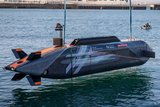
The Stidd MRCC (top left in surface mode and top right submerged), Armacraft Trident Mk1 (bottom left) and Armacraft Trident Mk2 (bottom right) are examples of semi-submersible craft. (Photos: Stidd/Armacraft)
Semi-submersible craft could present opportunities for USSOCOM in covert operations.


Semi-submersibles could prove to be a crucial enabler for SOF to conduct stealthy infiltration in littoral waters — but it appears that US Special Operations Command (USSOCOM) has no specific requirement in place for dual-function craft that can operate on the surface or dive and propel underwater.
Is USSOCOM missing an opportunity? Mark Cancian, a senior advisor at the Center for Strategic and International Studies (CSIS), offered Shephard his insight on possible semi-submersible usage.
‘Semi-submersibles have received a lot of attention because of their stealthiness and simplicity, not having the complexity of a full submarine. Given SOCOM’s interest in covert
Our news & analysis is now part of Defence Insight®
A Basic-level or higher Defence Insight subscription is now required to view this content.



More from Naval Warfare
-
![Autonomy gives Turkey a chance to outflank established naval shipbuilders]()
Autonomy gives Turkey a chance to outflank established naval shipbuilders
Turkish shipbuilders have sold ships from Asia to Europe, but autonomy and swarm technology could give them a fairer fight against Western European rivals.
-
![Canada assesses security equipment changes for Polar Icebreaker Imnaryuaq]()
Canada assesses security equipment changes for Polar Icebreaker Imnaryuaq
The Canadian Department of National Defence is evaluating communications and reconnaissance changes for CCGS Imnaryuaq’s expanded maritime security role, while retaining its 2032 acceptance target.
-
![All eyes on Royal Navy’s Type 93 market engagement as industry prepares bids]()
All eyes on Royal Navy’s Type 93 market engagement as industry prepares bids
Responses are due by 29 October as the Royal Navy tests the market, with BAE Systems’ Herne and MSubs’ Excalibur setting up a contest where payloads may decide the winner.
-
![US Navy’s MQ-25 Stingray approaches carrier-integration tests]()
US Navy’s MQ-25 Stingray approaches carrier-integration tests
Boeing has outlined its upcoming precision-landing and carrier-airspace trials as MQ-25 manufacturing shifts towards Illinois, with initial Lot 1 deliveries expected in 2029.