Canadian Offshore Patrol Ship contract awarded


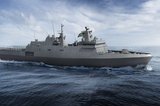
The Public Works and Government Services department of Canada has awarded a contract for six Arctic Offshore Patrol Ships (AOPS) to Irving Shipbuilding, the department announced on 23 January.
Under the contract worth C$2.3 billion ($1.85 billion), the company will construct six AOPS as part of the national shipbuilding procurement strategy.
Construction of an initial block for the first AOPS is scheduled for the summer, while full production will commence in September 2015. Delivery of the first HMCS Harry DeWolf class ship is expected in 2018.
The new DeWolf-class Arctic Offshore Patrol Ships will be equipped with state of the art sensors and will also be able to operate and support the new CH-148 Cyclone naval helicopters. Operating in conjunction with other capabilities of the Canadian armed forces and the Canadian Coast Guard, the DeWolf-class ships will play a critical role in the Atlantic, the Pacific and the Arctic.
The AOPS will have a number of capabilities, including: the ability to operate in first-year ice up to one metre in thickness; the ability to sustain operations for up to four months; command, control and communication capability to exchange real-time information with the armed forces maritime security operations centres; modern surface search radars; and a gun armament.
Related Equipment in Defence Insight


More from Naval Warfare
-
![Frigates and submarines anchor Brazilian naval modernisation worth US$5.52 billion]()
Frigates and submarines anchor Brazilian naval modernisation worth US$5.52 billion
Shipbuilding programmes established over the past decade are setting Brazil's course towards having one of the most modern navies in the region.
-
![Subsea surveillance: why connecting military and civilian assets could be crucial]()
Subsea surveillance: why connecting military and civilian assets could be crucial
As costs rise and threats multiply, maritime awareness is shifting from platforms to networks, and civilian infrastructure plays a central role.
-
![Shoreline vulnerability drives Gulf interest in USV networks]()
Shoreline vulnerability drives Gulf interest in USV networks
Ukraine’s combat-proven Magura uncrewed surface vessel is attracting Gulf state interest as the Iran war exposes gaps in layered maritime air defence, raising questions about whether low-cost attritable systems can gain a foothold in a procurement culture historically drawn to high-end Western platforms.
-
![Partnerships will be critical for future projects at Latin American shipyards]()
Partnerships will be critical for future projects at Latin American shipyards
Multiple Latin American navies are modernising their fleets by prioritising domestically manufactured surface vessels and even submarines via international partnerships.