Iran launches ‘cruise missile capable’ submarine
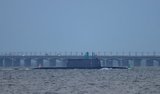
On 17 February 2019, Iran launched a new locally-made submarine capable of firing cruise missiles, state TV said, in the country’s latest show of military might at a time of heightened tensions with the US.
The launch ceremony, led by President Hassan Rouhani, took place in the southern port city of Bandar Abbas. ‘Today, the Islamic Republic of Iran is fully self-reliant on land, air and sea,’ Rouhani said. ‘Our defensive power is meant to defend our interests and we have never sought to attack any country,’ he added.
Named the Fateh (Farsi for ‘Conqueror’), Fars news agency said the new submarine is Iran’s first in the semi-heavy category, filling a gap between the light Ghadir class and the heavy Kilo class submarines that the country possesses.
Fars said the near 600-tonne underwater vessel is equipped with torpedoes and naval mines in addition to cruise missiles, and can operate more than 200 metres below sea level for up to 35 days.
The US withdrew from a 2015 multilateral nuclear deal with Iran in May 2018 and re-imposed biting unilateral sanctions later last year.
Iran’s Revolutionary Guards on February 7 unveiled a new ballistic missile with a range of 1,000 km, according to the elite unit’s official media agency Sepah News.
The surface-to-surface missile - called Dezful - is an upgrade on the older Zolfaghar model that had a range of 700 km, aerospace commander Brigadier General Amirali Hajizadeh said.
Rouhani said on Sunday that ‘pressure by enemies, the (Iran-Iraq) war and sanctions’ were incentives for Tehran to be self-reliant in its defence industry. ’Maybe we would not have this motivation to industrialise our defence sector,’ he said, if Iran could just buy the weaponry it needed.
Iran’s top military brass and cabinet ministers attended the ceremony.



You may also like
More from Naval Warfare
-
![Argentina’s submarine and frigate acquisitions resurface with $3.5bn funding plan]()
Argentina’s submarine and frigate acquisitions resurface with $3.5bn funding plan
Buenos Aires set out foreign loans worth $3.5 billion in its draft 2027 budget, opening a contest in which Naval Group and TKMS could lead the field.
-
![AUKUS heavyweight torpedo test raises questions over future armed UUV requirements]()
AUKUS heavyweight torpedo test raises questions over future armed UUV requirements
A heavyweight torpedo firing from the Royal Navy’s uncrewed submarine XV Excalibur suggests a shift beyond surveillance, with allied navies eyeing strike roles for large autonomous undersea vessels.
-
![Industrial teams prepare roadmap for Indonesia aircraft carrier transformation]()
Industrial teams prepare roadmap for Indonesia aircraft carrier transformation
Fincantieri and PT PAL have agreed on a framework to modernise the former Giuseppe Garibaldi, with drones, communications and broader Italian–Indonesian industrial ties involved.
-
![Denmark’s air defence frigate requirement draws growing European competition]()
Denmark’s air defence frigate requirement draws growing European competition
With no formal competition under way, industrial partnerships, production capacity and air defence capability could all shape the programme as Denmark considers how to replace its three Iver Huitfeldt-class frigates.
-
![Five years on: where could opportunities emerge next for AUKUS Pillar II?]()
Five years on: where could opportunities emerge next for AUKUS Pillar II?
Payload commonality, combat systems and electronic warfare are emerging as likely priorities as the trilateral partnership balances building submarines with sharing industrial ecosystems.
-
![Singapore expands maritime presence with future-ready Sentinel OPV]()
Singapore expands maritime presence with future-ready Sentinel OPV
Singapore is building space for uncrewed systems and future technologies into its new Sentinel-class OPVs, reflecting a wider move towards adaptable vessels capable of maintaining persistent maritime presence.