Indian Navy ships participate in Group Sail exercise


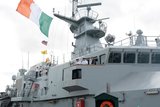
Indian Navy ships, Kolkata and Shakti, have carried out a Group Sail exercise with naval ships of Japan, Philippines and the US in the South China Sea, the Indian Navy announced on 9 May.
The Group Sail from 3-9 May 2019 witnessed the participation of six combatants from the four participating countries including the guided missile destroyer INS Kolkata and fleet support ship INS Shakti of the Indian Navy, helicopter carrier JMSDF Izumo and destroyer JMSDF Murasame of Japan; frigate BRP Andres Bonifacio of the Philippines and Arleigh Burke class destroyer USS Williams P Lawrence of the US. The Group Sail was aimed at deepening existing partnerships and fostering mutual understanding among participating navies.
The ships undertook various exercises enroute, including formation manoeuvring, underway replenishment runs, cross-deck flying and exchange of sea riders.
INS Kolkata and Shakti are on return passage from their successful deployment to South and East China Seas as part of the annual Eastern Fleet Overseas Deployment during which they visited Cam Ranh Bay, Vietnam, Qingdao, China and Busan, South Korea.
On departing Busan, both ships participated in ADMM-PLUS MS FTX Phase I exercises from 1-3 May 2019 off South Korea with the navies of Brunei, China, Malaysia, Philippines, Singapore, South Korea and the US.
The Phase II of ADMM-PLUS MS FTX is scheduled from 9-12 May 2019 in the South China Sea. On completion of Phase II, all participating ships including INS Kolkata and Shakti are scheduled to attend the closing ceremony of ADMM-PLUS MS and participate in the International Maritime Defence Expo 2019 in Singapore.

More from Naval Warfare
-
![US turns to allies to tackle navy shipbuilding backlog]()
US turns to allies to tackle navy shipbuilding backlog
A White House memorandum acknowledges US Navy shipbuilding backlogs and a weakened industrial base, opening a formal path for South Korean and Japanese yards to help rebuild capacity.
-
![US Navy’s $275 billion BBGN plan hinges on shipyard transformation]()
US Navy’s $275 billion BBGN plan hinges on shipyard transformation
The US Navy’s planned nuclear-powered warship carries a US$275 billion price tag, but the greater story lies in the industrial overhaul needed to build it, from AI-enabled design to digital twins and modular construction.
-
![Industry sees opportunity in Australia’s shift to networked undersea warfare]()
Industry sees opportunity in Australia’s shift to networked undersea warfare
Australia’s new defence innovation strategy indicates a shift from platform-centric to network-centric undersea warfare, with Ocius and Anduril Industries pointing to fast-growing opportunities for local industry.
-
![Asia-Pacific emerges as the largest export market for US-made USVs]()
Asia-Pacific emerges as the largest export market for US-made USVs
Asian customers have placed one of the largest known international purchases of US-built uncrewed surface vessels, highlighting accelerating regional demand for autonomous maritime capabilities and distributed naval operations.