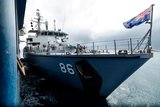
HMS Pembroke participates in NATO exercise


The British Royal Navy’s HMS Pembroke, a Sandown class minehunter, has participated in a NATO exercise, the navy announced on 7 June. The ship worked as a part of Standing Mine Counter Measures Group 1 (SMCMG1).
The task group for Exercise Open Spirit included 14 NATO and partner nations – the US, Sweden, Poland, Norway, the Netherlands, Lithuania, Latvia, Germany, France, Estonia, Denmark, Canada and Belgium.
The mine-hunter operated off the coast of Lithuania and covered 54nm2 of seabed, scanning and identifying around 912 objects. Of these objects, 15 mines and three torpedoes turned out to be explosive ordnance and were tackled by the task group.
Wrecks of three ships, three exercise mines, 34 mine chairs and parts from two rockets were also identified by the scanning.
HMS Pembroke located a Russian mine from the First World War in the approaches of Lithuania’s Klaipeda harbour, using its sonar system. It then deployed a remote underwater vehicle for positive identification of the object, after which explosive ordnance disposal divers disposed of the mine.
Lt Cdr Jim Lovell, Commanding Officer of HMS Pembroke, said: ‘For six of Pembroke’s crew this was their first deployment and the opportunity to work as part of NATO in the Baltic region is not something which many on board have experienced before. It was a good result for HMS Pembroke and demonstrates the unique capability that mine hunters provide for the Royal Navy and NATO.’
Related Equipment in Defence Insight

You may also like

More from Naval Warfare
-
![Competitive P17B tender marks a shift in Indian Navy frigate procurement]()
Competitive P17B tender marks a shift in Indian Navy frigate procurement
The Indian Navy's P17B programme is expected to combine greater weapons capacity with a competitive domestic construction model, although key systems could remain dependent on international supply chains.
-
![How France’s SNLE 3G programme is reshaping the naval nuclear industrial base]()
How France’s SNLE 3G programme is reshaping the naval nuclear industrial base
Extending far beyond a four-submarine replacement programme, France’s ballistic missile submarine effort is a decades-long industrial initiative designed to preserve the country’s ability to build and sustain nuclear-powered strategic platforms.
-
![China’s mineral processing dominance exposes naval supply chain vulnerabilities]()
China’s mineral processing dominance exposes naval supply chain vulnerabilities
Competition for critical minerals, and China’s dominance of their processing, is emerging as a decisive factor in future naval procurement programmes.
-
![Suppliers await next step in Australia’s mine warfare transition]()
Suppliers await next step in Australia’s mine warfare transition
Australia’s mine countermeasure capability remains in flux as the Huon-class nears retirement, but accelerated investment in autonomous systems is opening a path for industry.
-
![Can the US Navy ask Indo-Pacific allies to do more while training with them less?]()
Can the US Navy ask Indo-Pacific allies to do more while training with them less?
As the Iran War draws US ships and marine corps units away from the Indo-Pacific, curtailed exercises and a temporary carrier gap are exposing tensions between Washington’s demand for more self-reliant allies and the joint training needed to realise that ambition.