New Zealand's HMNZS Te Mana successfully fires first Sea Ceptor missile
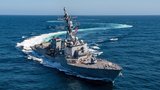
The successful firing of a SeaCeptor missile is a demonstration of a new combat management system. (Photo: Lockheed Martin)
CMS 330 is a combat management system developed by Lockheed Martin Canada that serves as the backbone for several Canadian and Chilean ship classes and has been installed on RNZN Anzac-class frigates.


Royal New Zealand Navy (RNZN) Anzac-class frigate HMNZS Te Mana has completed an initial test-firing of a Sea Ceptor missile using newly installed Lockheed Martin Canada 330 Combat Management System (CMS 330) as well as a new suite of sensors and weapons.
CMS 330 serves as the backbone of two ship classes in Canada, the Halifax Class frigates and the Harry DeWolf Class Arctic and Offshore Patrol Ships.
It will also be installed on three new Canadian ship classes: the Protecteur Class Joint Support Ships, the Canadian Surface Combatants and the Canadian Coast Guard variant of the Arctic and Offshore Patrol Ships.
Jason Locke, Integrated Project Team Lead, New Zealand MoD said: ‘The successful firing of a Sea Ceptor missile from HMNZS Te Mana is the culmination of Operational Testing and Evaluation of the Frigate Systems Upgrade project for the two New Zealand Anzac frigates.
‘The integration of multiple mission systems, sensors, and weapons systems with the CMS 330 has been successfully proven over the past twelve months of operations and testing.’
In addition to RNZN and , CMS 330 has also been integrated on three Chilean Navy (Armada de Chile) frigates, strengthening the partnership and naval interoperability between the RNZN, the Armada de Chile and the Royal Canadian Navy.
Related Equipment in Defence Insight

More from Naval Warfare
-
![Ireland releases maritime strategy as it looks to new naval bases and stronger partnerships]()
Ireland releases maritime strategy as it looks to new naval bases and stronger partnerships
Ireland has a maritime area ten times the size of its land mass but has a limited naval capacity and faces an ongoing threat to critical underwater infrastructure. A new strategy is looking to address the challenge.
-
![How the Golden Fleet will change the US Navy acquisition process]()
How the Golden Fleet will change the US Navy acquisition process
The procurement of the future USN Golden Fleet is planned to be less bureaucratic than previous strategies, involving AI-enabled designs and scheduling tools to increase productivity and avoid delays.
-
![What capabilities are being tested under AUKUS Pillar II?]()
What capabilities are being tested under AUKUS Pillar II?
Collaboration on AUKUS Pillar II extends beyond the core trilateral agreement, presenting global opportunities for companies with advanced technologies.