RAN conducts advance force training


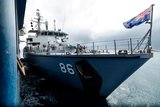
The Royal Australian Navy’s (RAN’s) HMAS Huon has put its mine countermeasures equipment and helicopter operations to the test as part of Exercise Ocean Explorer, the navy announced on 13 March.
The mine hunter tested its Type 2093 variable depth sonar for accuracy and carried out vertical replenishment and personnel transfers with aircraft from 723 Squadron.
Ocean Explorer was a multinational exercise designed to test the navy’s ability to conduct high-end warfare. RAN vessels Huon, Diamantina and Yarra conducted maritime advance force training in various locations around Australia.
Huon successfully conducted all validation trials of the Type 2093 sonar; operational analysis and reports are being compiled. The sonar can be operated in hull-mounted mode or in variable depth mode, with dual-frequency search and classification capability. In the variable depth mode both frequencies operate simultaneously, the lower frequency covering mid-water to surface depths and the higher frequency covering the seabed. The system has a detection range greater than 1000m and a classification range greater than 200m.
Commanding Officer Lieutenant Commander Jason Mullen, said: ‘We need to be fully cognisant of our system’s capabilities as this affects how we train and do business.
‘The mine hunters ensure a body of water is safe for shipping prior to the arrival of the follow-on forces, such as an amphibious platform. Once the mine hunters, the clearance diving teams and the mine warfare teams have reduced any potential mine threat to a minimum, the amphibious landing can begin.’

You may also like
More from Naval Warfare
-
![Suppliers await next step in Australia’s mine warfare transition]()
Suppliers await next step in Australia’s mine warfare transition
Australia’s mine countermeasure capability remains in flux as the Huon-class nears retirement, but accelerated investment in autonomous systems is opening a path for industry.
-
![Can the US Navy ask Indo-Pacific allies to do more while training with them less?]()
Can the US Navy ask Indo-Pacific allies to do more while training with them less?
As the Iran War draws US ships and marine corps units away from the Indo-Pacific, curtailed exercises and a temporary carrier gap are exposing tensions between Washington’s demand for more self-reliant allies and the joint training needed to realise that ambition.
-
![How could Rheinmetall’s GMF 140 fit with ongoing programmes in North America?]()
How could Rheinmetall’s GMF 140 fit with ongoing programmes in North America?
With Canada committed to its River-class replacement and the USN pursuing a lower-cost frigate, Rheinmetall will need to demonstrate where the GMF 140 can fill a capability gap in the North American fleet.
-
![Australian industry programme builds pipeline for Virginia-class sustainment]()
Australian industry programme builds pipeline for Virginia-class sustainment
Australian businesses can now bid to support Virginia-class submarine sustainment in Western Australia, as momentum around the Henderson Defence Precinct also builds.
-
![South Korea, Japan and Turkey vie for US shipbuilding access in future frigate contest]()
South Korea, Japan and Turkey vie for US shipbuilding access in future frigate contest
Washington’s search for a foreign-built frigate could hand South Korea, Japan and Turkey a larger prize than a double-hull order: a foothold inside the US shipbuilding industrial base.