GSL delivers OPV to Sri Lankan Navy


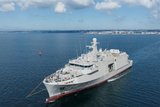
Goa Shipyard (GSL) delivered a new offshore patrol vessel (OPV) to the Sri Lankan Navy on 22 July 2017.
Designed in-house and built by GSL, the keel of the vessel was laid on 10 September 2014 and was the ship was launched on 5 May 2016.
The naval vessel is designed for patrolling and policing maritime zones, search and rescue, pollution control, external fire fighting and the operation of a light helicopter for long range search and surveillance. Powered by two diesel engines, the vessel delivers a maximum speed of 25 knots and has a range of 6500NM. It is armed with a 30mm gun system and two 12.7mm gun systems, both with fire control systems.
The shipyard is also currently building six OPVs for the Sri Lankan Coast Guard. The fifth of these was delivered earlier this month. The coast guard variant is more lightly armed with one 30mm gun and two 12.5mm super rapid chain guns.
Shekhar Mital, CMD, GSL, said: ‘First time in the history of GSL, we are handing over two OPVs within a gap of one month, against earlier minimum interval of five-six months.
‘In last 20 months, we have delivered five OPVs for coast guard, two fast patrol vessels and 11 FICs for Mauritius and this AOPV for Sri Lanka, besides other smaller projects, all ahead of schedule.’


More from Naval Warfare
-
![The UK joins the movement towards joint procurement]()
The UK joins the movement towards joint procurement
The UK will spend an estimated US$3.89 billion over the next decade in joint naval programmes, a lot of which will be in cooperation with Norway.
-
![Rheinmetall’s GMF 140: Ambitious frigate or market misfit?]()
Rheinmetall’s GMF 140: Ambitious frigate or market misfit?
Rheinmetall has unveiled its first next-generation frigate design, showing ambitions to compete as a surface combatant prime contractor. While the company is targeting North America, analysts believe the concept may be better positioned for future European programmes.
-
![US Navy $76.6bn award provides stability for submarine production]()
US Navy $76.6bn award provides stability for submarine production
The US Department of War’s US$76.6 billion Columbia-and Virginia-class submarine contract gives industry demand certainty as Washington seeks to rebuild its shipbuilding base.
-
![Dreadnought Phase 4 opens £2.5 billion supply chain opportunity]()
Dreadnought Phase 4 opens £2.5 billion supply chain opportunity
The UK government’s £8.4 billion Dreadnought Phase 4 investment sets aside £2.5 billion for the wider submarine supply chain, opening new work beyond BAE Systems’ prime contract.
-
![Hanwha Ocean deepens US ties and eyes Saudi submarine prospect after Canada setback]()
Hanwha Ocean deepens US ties and eyes Saudi submarine prospect after Canada setback
Hanwha Ocean is deepening ties with the US and eyeing a submarine opportunity in Saudi Arabia, as South Korea looks to convert its Canadian defeat into export momentum.