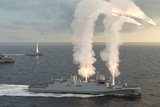
Germany christens new frigate Nordrhein-Westfalen
The second of four F125 class frigates of the German Navy was christened Nordrhein-Westfalen in a ceremony at the ThyssenKrupp Marine Systems facility in Hamburg on 16 April.
The first frigate was christened Baden-Württemberg in December 2013. The Nordrhein-Westfalen is expected to be handed over to the German defence procurement agency BAAINBw in mid-2018.
The contract for the four frigates is worth around $2.16 billion in total. The ARGE F125 consortium received the contract for the four F125 class ships in 2007, with ThyssenKrupp Marine Systems as the lead company. Fr. Lürssen Werft shipyards are constructing the pre-fitted bow sections, while Blohm+Voss Shipyards are constructing the stern sections, joining the two sections and fitting out the ships.
The frigates will replace the 122 Bremen class frigates, eight of which are operated by the navy at present. They are designed for conflict prevention, crisis management, and international intervention and stabilisation missions.
Hans Christoph Atzpodien, CEO, ThyssenKrupp Industrial Solutions, said: ‘The F125 class is a completely new type of ship with innovations across numerous fields of technology. It showcases our leading engineering expertise and points the way forward for German naval shipbuilding.’



You may also like
More from Naval Warfare
-
![How France’s SNLE 3G programme is reshaping the naval nuclear industrial base]()
How France’s SNLE 3G programme is reshaping the naval nuclear industrial base
Extending far beyond a four-submarine replacement programme, France’s ballistic missile submarine effort is a decades-long industrial initiative designed to preserve the country’s ability to build and sustain nuclear-powered strategic platforms.
-
![China’s mineral processing dominance exposes naval supply chain vulnerabilities]()
China’s mineral processing dominance exposes naval supply chain vulnerabilities
Competition for critical minerals, and China’s dominance of their processing, is emerging as a decisive factor in future naval procurement programmes.
-
![Suppliers await next step in Australia’s mine warfare transition]()
Suppliers await next step in Australia’s mine warfare transition
Australia’s mine countermeasure capability remains in flux as the Huon-class nears retirement, but accelerated investment in autonomous systems is opening a path for industry.
-
![Can the US Navy ask Indo-Pacific allies to do more while training with them less?]()
Can the US Navy ask Indo-Pacific allies to do more while training with them less?
As the Iran War draws US ships and marine corps units away from the Indo-Pacific, curtailed exercises and a temporary carrier gap are exposing tensions between Washington’s demand for more self-reliant allies and the joint training needed to realise that ambition.
-
![How could Rheinmetall’s GMF 140 fit with ongoing programmes in North America?]()
How could Rheinmetall’s GMF 140 fit with ongoing programmes in North America?
With Canada committed to its River-class replacement and the USN pursuing a lower-cost frigate, Rheinmetall will need to demonstrate where the GMF 140 can fill a capability gap in the North American fleet.