German Navy frigate begins in-port trials


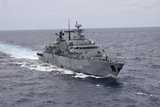
The German Navy’s third F125 class frigate, the Sachsen-Anhalt, has sailed for the first time from the shipyard in Hamburg, Thyssenkrupp announced on 22 February.
The ship will undergo in-port trials, which will see its technical systems and equipment, including propulsion system, manoeuvring behaviour and technical operations, tested over a period of around two weeks.
For the trials, the ship will sail from Hamburg via the river Elbe to the North Sea before returning to Hamburg. Onboard is the technical team from the German defence procurement agency, the testing team from the ARGE F125 consortium and members of the future crew.
The Sachsen-Anhalt is the third of the F125 class frigates to take to the open seas after the Baden-Württemberg and the Nordrhein-Westfalen.
The F125 class ships have been designed with a high degree of automation. The vessels are capable of conducting sea operations for up to two years with a smaller crew and a multiple-crew strategy enables the entire crew to be changed during deployment.
The ARGE F125 consortium, which was awarded the contract for the German Navy’s F125 programme in 2007, comprises Thyssenkrupp Marine Systems as the lead company and Lürssen Werft. Blohm+Voss Shipyards is manufacturing stern sections, joining the two sections and carrying out further fitting out.

You may also like

More from Naval Warfare
-
![US Navy’s $275 billion BBGN plan hinges on shipyard transformation]()
US Navy’s $275 billion BBGN plan hinges on shipyard transformation
The US Navy’s planned nuclear-powered warship carries a US$275 billion price tag, but the greater story lies in the industrial overhaul needed to build it, from AI-enabled design to digital twins and modular construction.
-
![RTX confirms US Marine Corps and US Navy acquire Hadalus UUV]()
RTX confirms US Marine Corps and US Navy acquire Hadalus UUV
RTX told Shephard that the Hadalus UUV has been procured by the US Marine Corps and the Office of Naval Research for operational experimentation as the company prepares additional demonstrations with the US Navy, NATO and AUKUS partners.
-
![Europe’s naval contractors benefit from growing refit and upgrade demand]()
Europe’s naval contractors benefit from growing refit and upgrade demand
Rheinmetall’s order to modernise the German Navy frigate Bayern points to a wider European shift towards extending warship service life as new-build programmes face delay.
-
![The UK joins the movement towards joint procurement]()
The UK joins the movement towards joint procurement
The UK will spend an estimated US$3.89 billion over the next decade in joint naval programmes, a lot of which will be in cooperation with Norway.