German Navy christens frigate Nordrhein-Westfalen


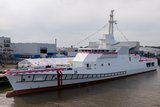
The German Navy christened the second 125 class frigate as Nordrhein-Westfalen in a ceremony at ThyssenKrupp Marine Systems’ Hamburg site on 16 May.
The Nordrhein-Westfalen, which is the second of four contracted 125 class frigates, is scheduled to be handed over to German defense procurement agency in mid-2018. The contract for the frigates is worth around $2.28 billion and was awarded to the ARGE F125 consortium, which is led by ThyssenKrupp Marine Systems.
The pre-fitted bow sections are being manufactured at the Fr. Lürssen Werft shipyards in Bremen and Wolgast. The stern sections are being constructed and the two sections are joined and other fitting operations are being carried out at Blohm+Voss Shipyards in Hamburg.
The 125 class frigates will replace the eight 122 Bremen class frigates of the navy. They are designed for conflict prevention, crisis management, and international intervention and stabilisation missions. Each frigate has a length of 149m, width of 18m and maximum speed of 26 knots.
Hans Christoph Atzpodien, CEO, ThyssenKrupp Industrial Solutions, said: ‘ThyssenKrupp has its roots in the Ruhr region, so it is even more pleasing that North Rhine-Westphalia is acting as sponsor for the second frigate. The F125 class is a completely new type of ship with innovations across numerous fields of technology. It showcases our leading engineering expertise and points the way forward for German naval shipbuilding.’


More from Naval Warfare
-
![Five years on: where could opportunities emerge next for AUKUS Pillar II?]()
Five years on: where could opportunities emerge next for AUKUS Pillar II?
Payload commonality, combat systems and electronic warfare are emerging as likely priorities as the trilateral partnership balances building submarines with sharing industrial ecosystems.
-
![From the Baltic to the Gulf: where USV procurement is heading next]()
From the Baltic to the Gulf: where USV procurement is heading next
Saildrone’s new Copenhagen base is one sign of a larger shift, as navies globally turn to uncrewed vessels for surveillance and mine clearance.
-
![Quantum sensing gathers pace as navies eye undersea advantage]()
Quantum sensing gathers pace as navies eye undersea advantage
As AI dominates defence conversations, industry increasingly points to quantum sensing as the technology set to change submarine and uncrewed underwater vehicle operations.