France tests subsea robotics for future seabed mapping missions
Sonar image from A18D AUV. (Photo: ECA Group)
French Navy and DGA put an autonomous underwater vehicle through its paces.


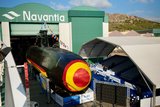
The French Navy and Naval Hydrographic and Oceanographic Service (SHOM), working with the national procurement agency DGA, have evaluated the A18D autonomous underwater vehicle (AUV) from ECA Group.
This evaluation was conducted with the Future Hydrographic and Oceanographic Capacity (CHOF) programme in mind, ECA stated on 11 October.
The AUV was launched from the French Navy offshore support vessel Rhône on ‘a large variety of missions to precisely map the relief and sea beds down to 3000m depth, in the currents and swell of the Atlantic’, the company added.
The A18D can function autonomously for 24h to carry out inspection and 3D seabed mapping missions.
‘The example of the A18D tested showed a high level of reliability and proved to be easy to install and operate, thanks to its optimised size-to-weight ratio (5.7m-780kg) and its intuitive user interface.’
In addition, the French Navy and SHOM teams were able to evaluate the potential of using a UAV to ‘accompany and enrich’ subsea robotic missions, ECA noted.
CHOF is intended to update and develop French oceanographic and hydrographic data acquisition and processing capabilities, by replacing three crewed vessels with autonomous platforms.

More from Naval Warfare
-
![Industry agreements point to growing interest in Danish hybrid fleet concept]()
Industry agreements point to growing interest in Danish hybrid fleet concept
Babcock’s new Danish industry agreements have reignited debate over whether Copenhagen is edging towards a hybrid fleet blending crewed frigates with autonomous systems.
-
![Armada 2050: can Spain deliver its naval transformation?]()
Armada 2050: can Spain deliver its naval transformation?
Spain’s naval modernisation drive is moving from concept to contracts, with RfIs and RfPs expected before the end of the decade, despite second-batch frigate and submarine numbers remaining undecided.
-
![US turns to allies to tackle navy shipbuilding backlog]()
US turns to allies to tackle navy shipbuilding backlog
A White House memorandum acknowledges US Navy shipbuilding backlogs and a weakened industrial base, opening a formal path for South Korean and Japanese yards to help rebuild capacity.