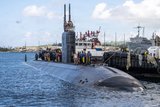
How the Hedge Strategy will impact the US Navy’s future capabilities
The US Navy Hedge Strategy is intended to provide a lethal, modular and cost-effective fleet while accepting Washington’s fiscal and industrial constraints.
With a budget of €1.2 billion, the Finnish navy is bolstering its fleet with its Squadron 2020 (Laivue 2020) project moving forward at pace.
Most recently the main contractor, the Finnish Defence Forces Logistics Command (FDFLOGCOM), signed a contract with Rauma Marine Constructions (RMC) for the design of four Squadron 2020 project multi-role corvettes.
Separately, FDFLOGCOM selected Atlas Elektronik, Lockheed Martin Canada and Saab to battle it out for the Squadron 2020 combat system.
The navy is expecting to select one of these competitors and sign a contract within the next 12 months, according to Cmdr Jon von Weissenberg, project
Already have an account? Log in
The US Navy Hedge Strategy is intended to provide a lethal, modular and cost-effective fleet while accepting Washington’s fiscal and industrial constraints.
Designed as an anti-torpedo and anti-submarine capability, the USN and RTX foresee the Compact Rapid Attack Weapon’s potential for deployment from surface ships and aerial and uncrewed platforms.
France, Germany and Italy lead the way on unawarded naval defence opportunities that could be awarded this year, but across Europe countries are ramping up their spending efforts to face geopolitical challenges.
The US multinational company is currently assembling 300 Rolling Airframe Missile rounds per year, with plans to reach 800 units annually after significant investment and modernisation of its facilities.
RTX’s solution for DARPA’s Pulling Guard programme is intended to provide advanced maritime defence technologies to protect platforms against uncrewed surface vehicles and other threats.
The Spanish Navy’s Alvaro de Bazan-class of air defence frigates will receive the latest Aegis Weapon System technology among other modernisations to extend the service life to 2045.